Most businesses are trapped in a broken content marketing process. They rely on keyword tools, generic AI prompts, and outdated SEO tactics — creating content that collects dust instead of clicks. Creating more content is not the answer. Creating the right content is. That is where LeafWorldMedia’s proprietary Buyer Journey Mapping and OmniCast distribution makes all the difference.
The Core Problem
Traditional content planning gives every marketer the same keyword suggestions — meaning everyone competes for the same topics. The result is content that ranks for terms with no buying intent, never reaches qualified audiences, and generates traffic without generating revenue. LeafWorldMedia’s Buyer Journey Mapping identifies the exact questions your customers are asking before they buy — then OmniCast distributes that content across 300+ platforms simultaneously, ensuring it gets consumed rather than ignored.
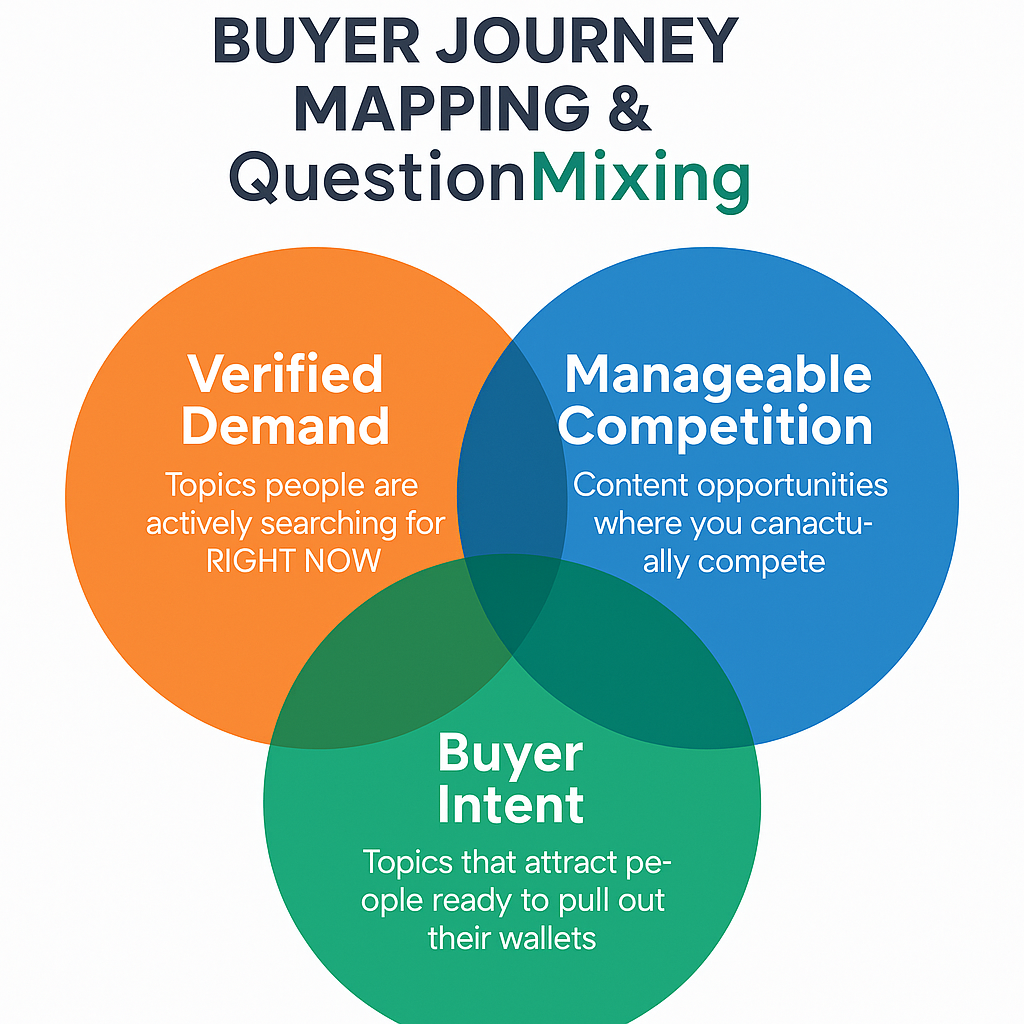
Buyer Journey Mapping identifies the exact questions customers ask at each stage of their purchase decision — allowing content to be created that attracts, educates, and converts rather than simply generating traffic.
The Problem With Traditional Content Planning
Most marketers unknowingly create content that either competes with hundreds of other blogs, fails to speak to real buyer needs, or never gets seen because it is published in the wrong places. The end result is wasted time, money, and effort with very little return.
Here is what traditional content planning gets wrong:
- Keyword tools give every marketer the same suggestions — meaning everyone competes for the same topics simultaneously
- Generic AI prompts produce bland, forgettable content that sounds like every other brand in the category
- Content ranks for terms with no buying intent — generating traffic that never converts
- Buzzwords like “topical authority” are pursued without any connection to actual buyer behavior or purchase decisions
- Distribution is an afterthought — meaning even well-written content reaches almost no one
The Fundamental Mistake: Most content marketing strategies start with what is easy to rank for rather than what buyers actually need to hear before they purchase. This creates a traffic-without-revenue problem — high impressions, low conversions, and constant pressure to produce more content without understanding why existing content is not working. Buyer Journey Mapping solves this by reversing the process: start with purchase behavior, then work backward to content topics.
LeafWorldMedia’s Buyer Journey Mapping Framework
Instead of guessing what content your audience might want, Buyer Journey Mapping identifies exactly what they need at every step of their purchase decision. This is done by studying human behavior, analyzing real-time platform data, and applying a framework that finds topics with actual business potential.
The Three-Stage Awareness Model
Stage 1 — Problem Aware
At this stage, the buyer knows they have a problem but does not yet know solutions exist. Content at this stage addresses symptoms, frustrations, and pain points in language the buyer uses themselves. This is where most brands are invisible — because they only create content about their product, not about the problem their product solves. Capturing buyers at this stage builds awareness before competitors even enter the conversation.
Stage 2 — Solution Aware
At this stage, the buyer knows solutions exist and is actively researching options. Content here covers comparisons, how-to guides, and methodology explanations. This is where Buyer Journey Mapping finds the highest-value topics — specific questions buyers ask when evaluating solutions that keyword tools miss entirely because the search volume appears low but purchase intent is extremely high.
Stage 3 — Product Aware
At this stage, the buyer is evaluating specific providers and making a final decision. Content here addresses objections, social proof, pricing questions, and differentiators. Buyers at this stage convert at dramatically higher rates than any other stage — but most brands only create content here, missing the opportunity to build relationships at stages 1 and 2 before competitors enter the picture.
The Golden Intersection — Where True ROI Lives
LeafWorldMedia’s Buyer Journey Mapping identifies topics that sit at the intersection of three critical factors simultaneously:
- Verified demand — topics people are actively researching right now on Google, YouTube, Reddit, and social platforms
- Manageable competition — topics where content has a real chance to rank and be discovered
- Buyer intent — topics that match what people are thinking immediately before they make a purchase decision
By identifying this sweet spot, every piece of content has a clear purpose: to attract, educate, and convert — not simply to generate traffic that never becomes revenue.
Case Study: 7,000+ Buyer Clicks From One Blog Post
A fitness brand came to LeafWorldMedia looking for traffic. Through Buyer Journey Mapping, the team discovered a niche question being asked across forums and YouTube: “What is the best treadmill for seniors with joint pain?” This topic did not appear in any standard keyword tool. However, the platform research revealed genuine demand from a highly specific, high-intent audience.
LeafWorldMedia created a blog post, infographic, and short-form video around that single buyer question. The results within one year:
- Over 7,000 clicks from Google in one year
- 38% conversion rate to email capture
- Featured snippet rankings for multiple related queries
- Direct buyer engagement through comments and purchase inquiries
LeafWorldMedia’s 3-Step Content Planning and Distribution Process

LeafWorldMedia’s 3-step process moves from buyer research to multi-format content creation to omnichannel distribution — ensuring content reaches the right audience at every stage of their purchase journey.
Step 1 — Research Buyer Questions in Context
Standard keyword research only captures what people type into search bars. Buyer Journey Mapping goes significantly deeper. Research combines:
- Questions buyers ask in forums, Reddit threads, and Facebook Groups
- YouTube video titles, descriptions, and comment sections
- Google autosuggestions and People Also Ask boxes
- Competitor content analysis based on engagement metrics rather than traffic estimates
- Emotional language and objections buyers express before purchasing
Step 2 — Create Content in Every Format Buyers Consume
Once the right topic is identified, content is created in the formats that match buyer preferences at each stage of the journey:
- SEO-optimized blog posts — driving evergreen search traffic for problem and solution-aware buyers
- Authority news articles — earning trust through high-authority media placements
- Videos — for YouTube discovery and social sharing
- Podcasts — for building personal authority and deeper engagement with solution-aware buyers
- Infographics — for visual storytelling and Pinterest discovery
- Flipbooks and slideshows — for social distribution and authoritative reference content
Step 3 — Distribute Across 300+ Platforms with OmniCast
Distribution is where most content strategies fail. Even well-researched, well-written content reaches almost no one when published only to a company blog. OmniCast by LeafWorldMedia publishes content simultaneously across:
- 300+ Google News-approved media websites
- Podcast platforms including Spotify and Apple Podcasts
- Video platforms including YouTube and Vimeo
- Social media including Instagram, Facebook, LinkedIn, and X
- Image and document platforms including SlideShare and Pinterest
The result is total content visibility — content that not only gets created but gets consumed by the exact audiences it was designed for. Learn how OmniCast works →
Traditional Methods vs. Buyer Journey Mapping
| Traditional Content Planning | Buyer Journey Mapping + OmniCast |
|---|---|
| Uses overused keyword tools — same data for every marketer | Uses real buyer questions from live platforms — unique insights competitors miss |
| Generic AI-generated content that sounds like everyone else | Human insight blended with guided AI — specific to actual buyer language |
| Ranks for terms with no buying intent | Focuses on conversion-driven search behavior tied to purchase decisions |
| Prioritizes quantity over strategy | Prioritizes impact over volume — fewer topics, higher ROI |
| Publishes once to one channel, then forgotten | Repurposed and distributed simultaneously across 300+ platforms |
| Topics not tied to revenue stages | Every topic mapped to a specific buyer awareness stage |
The QuestionMixing System
LeafWorldMedia’s proprietary QuestionMixing framework is the engine behind Buyer Journey Mapping. It works by:
- Identifying the exact questions buyers ask at each awareness stage — problem, solution, and product
- Mapping those questions to the buyer’s emotional state at each stage, not just their search intent
- Creating content that speaks directly to concerns at every stage rather than generically addressing a topic
- Mixing formats and angles to cover every possible entry point into the conversion funnel
- Designing content hubs that nurture buyers from first awareness through to purchase decision
This method ensures content marketing is not only SEO-friendly but sales-focused — with every piece of content connected to a measurable step in the buyer’s journey toward a purchase decision.
Frequently Asked Questions
What is Buyer Journey Mapping in content marketing?
Buyer Journey Mapping is the practice of identifying the specific questions, concerns, and information needs your potential customers have at each stage of their purchase decision — and then creating content specifically designed to address those needs at each stage. Unlike standard keyword research, which identifies what people search for, Buyer Journey Mapping identifies what buyers need to understand before they are ready to purchase. This produces content that generates qualified leads and conversions rather than simply traffic.
What are the three stages of the buyer journey?
The three stages are Problem Aware (the buyer knows they have a problem but does not know solutions exist), Solution Aware (the buyer is researching available solutions and comparing options), and Product Aware (the buyer is evaluating specific providers and making a final decision). Each stage requires completely different content — problem-focused content at stage one, comparison and methodology content at stage two, and objection-handling and social proof content at stage three. Most brands only create content for stage three, missing the vast majority of their potential audience.
Why does traditional keyword research miss buyer-intent topics?
Standard keyword tools measure search volume — how many people type a specific phrase into a search engine. However, the highest-value buyer questions are often asked in forums, Reddit threads, Facebook groups, YouTube comment sections, and other conversational platforms that keyword tools do not track. Furthermore, keyword tools show aggregate data that every marketer sees simultaneously — meaning everyone pursues the same topics. Buyer Journey Mapping finds questions with high purchase intent that competitors are not addressing because the questions do not appear in standard keyword research.
How does OmniCast amplify Buyer Journey Mapping results?
OmniCast takes buyer-journey-mapped content and distributes it simultaneously across 300+ high-authority platforms in 8 formats — news articles, blog posts, podcasts, videos, infographics, flipbooks, social posts, and video shorts — within 24–48 hours. This ensures that content reaching buyers at every stage of their journey is not limited to a single channel or format. When a problem-aware buyer searches YouTube, watches TikTok, or asks ChatGPT — OmniCast ensures your content appears across all of these touchpoints simultaneously, dramatically increasing the likelihood of being the brand that starts and continues the buyer relationship.
How is content quality maintained when distributing across 300+ platforms?
OmniCast does not simply copy the same content across every platform. Each of the 8 formats is created with professional quality appropriate to its distribution channel — realistic voiceovers for podcasts, polished visuals for infographics, properly structured articles for news sites, and platform-native formatting for social posts. The core message and buyer-journey-stage targeting remain consistent, while the format and presentation are optimized for each platform’s specific audience and algorithm preferences.
What results can I expect from Buyer Journey Mapping combined with OmniCast?
Results vary by industry and market competitiveness, but typical outcomes include significantly higher conversion rates from organic traffic (because content is specifically designed for buyer intent rather than general information), faster AI citation in Google AI Overviews and ChatGPT (because buyer-question content matches the format AI engines use for citations), and lower long-term cost per lead (because content assets compound over time rather than requiring continuous ad spend to generate results). The fitness brand case study achieved 7,000+ clicks and 38% email conversion from a single buyer-journey-mapped piece — without paid advertising.
How does Buyer Journey Mapping affect AI search recommendations?
AI answer engines like ChatGPT, Google Gemini, and Perplexity are specifically designed to answer questions — which means they heavily prioritize content structured around specific buyer questions rather than keyword-optimized articles targeting broad topics. Buyer Journey Mapping produces content in exactly the question-and-answer format that AI engines prefer as citation sources. When OmniCast distributes this content across 300+ authoritative platforms simultaneously, the consensus signal created causes AI engines to recognize the brand as the authoritative answer in its category.
Stop Creating Content That Fails to Convert
LeafWorldMedia’s Buyer Journey Mapping identifies exactly what your customers need to hear before they buy — and OmniCast distributes it across 300+ platforms in 8 formats within 24–48 hours.
📞 718-640-2855 | 📧 Info@LeafWorldMedia.com | 🌐 LeafWorldMedia.llc





Leave a Reply