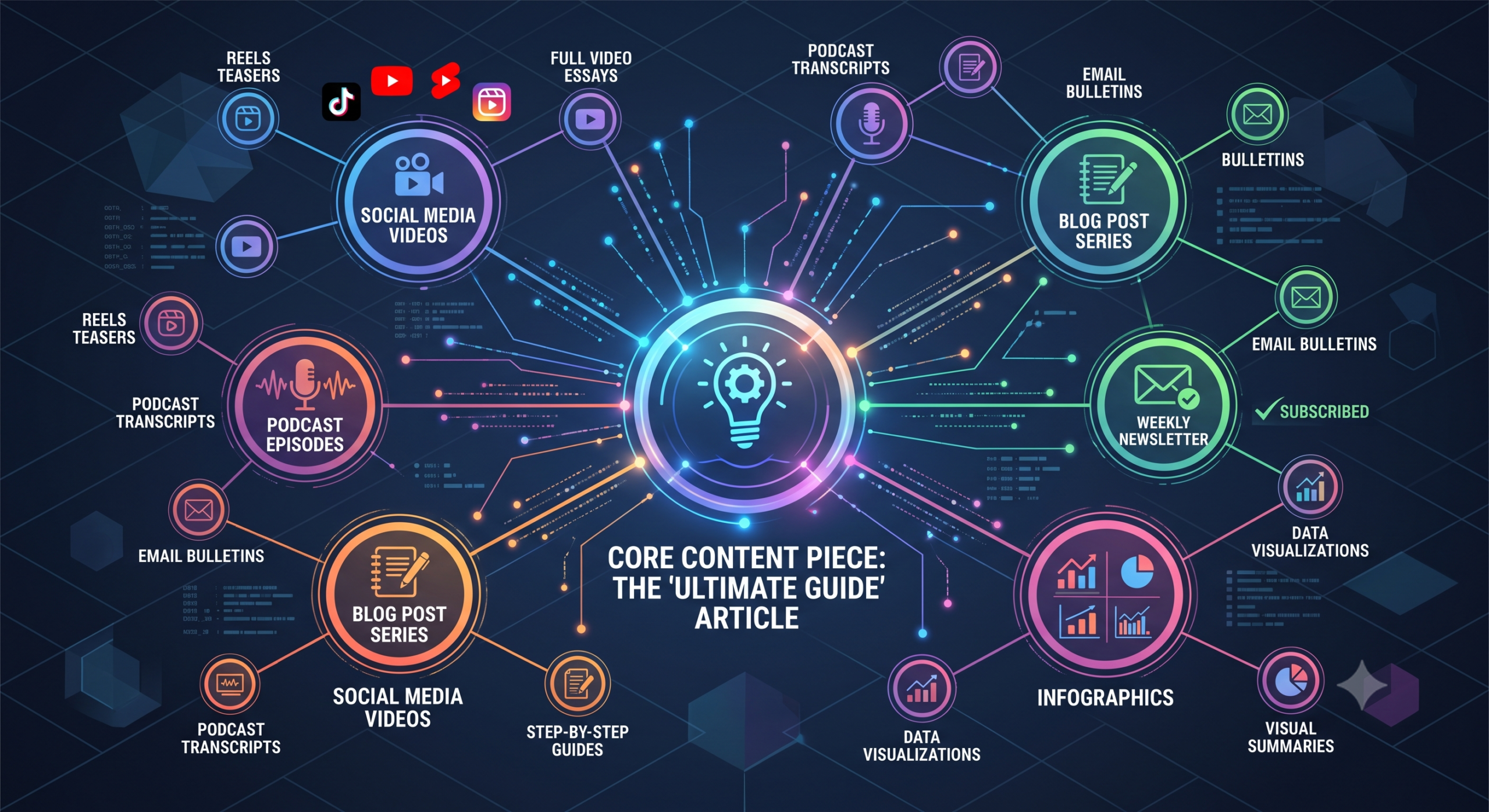
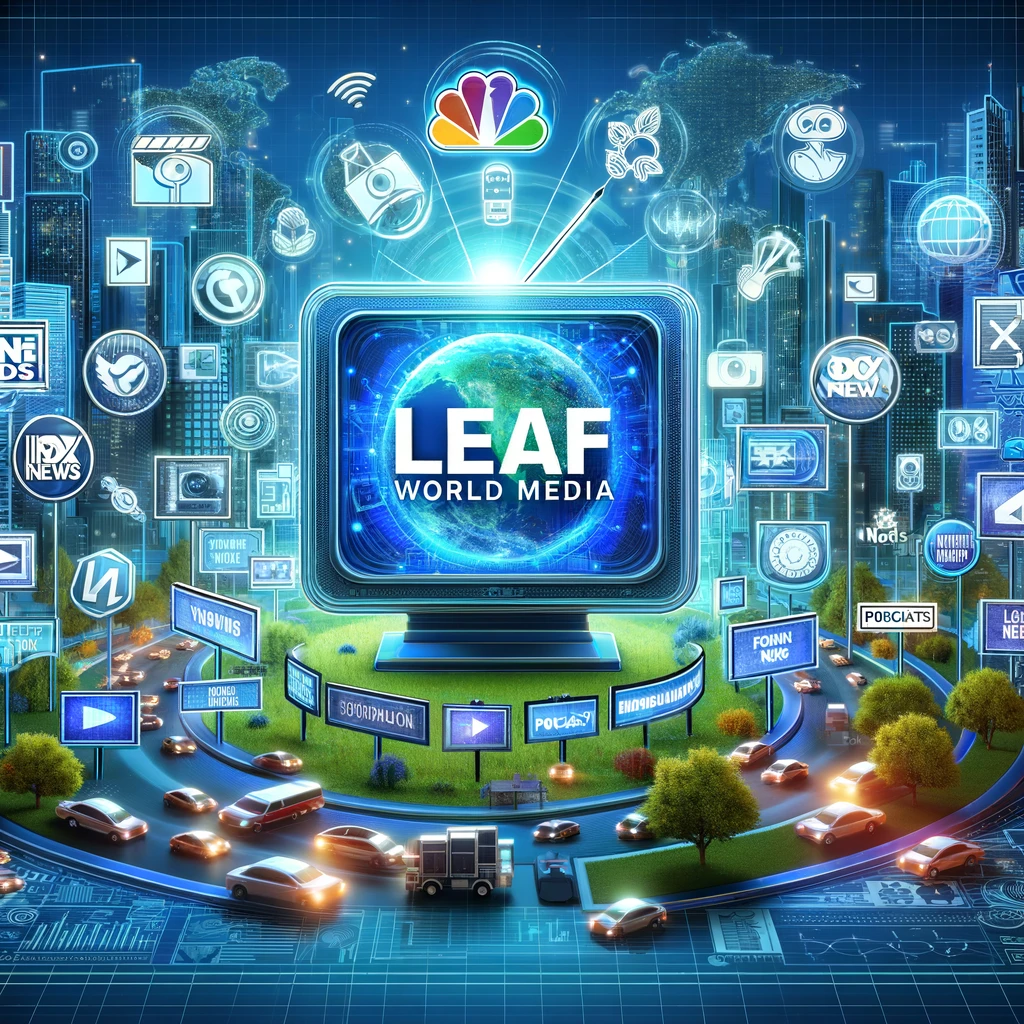
Content distribution turns one piece of content into a presence across the web.
If you’ve published a great blog post on your website and waited for it to get discovered, you’ve probably noticed something frustrating: nothing happens. Great content sitting alone on your own domain isn’t enough anymore — not for traditional search, and especially not for AI engines like ChatGPT and Perplexity. This is where content distribution comes in, and understanding it properly is one of the most important shifts in how modern marketing actually works.
Content distribution is the process of publishing and sharing content across multiple platforms and channels — beyond your own website — so it reaches a wider audience and builds broader brand authority. Instead of one blog post living only on your domain, distributed content appears across news sites, blogs, podcasts, video platforms, and social channels simultaneously.
- Why Your Website Alone Isn’t Enough
- The Evolution of Content Distribution
- Traditional PR vs. Modern Content Distribution
- How Content Distribution Builds AI Visibility
- The Formats That Make Up a Real Strategy
- How Distribution Actually Works, Step by Step
- Common Mistakes That Undermine Distribution
- How to Measure Whether It’s Working
- Frequently Asked Questions
Why Your Website Alone Isn’t Enough
Search engines and AI engines don’t just look at what you say about your own business — they look at what independent, external sources say about you. A single page on your own website is one data point. When that same core message appears across dozens or hundreds of independent platforms, it starts to look like consensus rather than self-promotion — and consensus is exactly what builds the kind of trust that gets a brand cited.
Think about how you personally decide whether to trust a business you’ve never heard of. You don’t just take their word for it — you look for other signals: reviews, mentions, news coverage, whether other credible sources talk about them. AI engines are doing something structurally similar when they decide which brands to recommend in an answer. A business that only exists on its own website, with no outside corroboration, is much harder for an AI engine to confidently recommend than one with a wide, consistent footprint across the web.
The Evolution of Content Distribution
Content distribution isn’t a brand-new concept — it’s an evolution of practices that have existed in different forms for decades, adapted to how information actually gets discovered today.
- Traditional press releases: For decades, businesses relied on wire services to push announcements to newspapers and media outlets. Reach was real but limited to whichever outlets picked up the story.
- Early digital SEO era: As search engines rose, distribution shifted toward backlink-building and guest posting, largely optimized for a single platform: Google.
- Social media era: Distribution expanded to native social content, but often existed in a separate silo from SEO and PR efforts, rarely coordinated together.
- The AI answer-engine era: Today, AI engines pull from a much broader and more varied set of sources than traditional search ever did — news sites, video platforms, podcasts, forums, and more. Effective distribution now has to span all of these simultaneously, not just optimize for one channel.
This last shift is the one most businesses haven’t caught up to yet — and it’s exactly the gap modern content distribution strategies are built to close.
Traditional PR vs. Modern Content Distribution
Traditional PR and modern content distribution solve a similar problem — getting your brand seen — but they work very differently in practice.
| Factor | Traditional PR | Content Distribution at Scale |
|---|---|---|
| Approach | Relationship-based pitching to a small number of outlets | Simultaneous placement across hundreds of platforms |
| Formats | Usually one format (press release or article) | Multiple formats: articles, video, podcast, social, and more |
| Timeline | Days to weeks per placement | 24–48 hours for full distribution |
| Scalability | Limited by relationships and outlet capacity | Built for repeatable, ongoing campaigns |
| Measurement | Often hard to track consistently | Full placement reports with live links |
| Best suited for | Major announcements, funding news, big launches | Ongoing authority-building and AI visibility |
Neither approach fully replaces the other — a major company milestone may still warrant traditional PR outreach. But for the ongoing, repeatable work of building AI and search visibility, distribution at scale is built for a different job: consistency and breadth rather than occasional big placements.
How Content Distribution Builds AI Visibility
AI engines like ChatGPT, Perplexity, and Google’s AI Overviews decide what to cite based on entity recognition — essentially, how confidently the AI can identify your brand as a real, trustworthy authority on a topic. That confidence is built through consistent signals: the same core facts about your business appearing across many independent sources, not just your own site.
This is different from traditional SEO, which focuses heavily on backlinks and keyword optimization for a single search engine. AI visibility depends more on breadth and consistency of mentions across the wider web — which is exactly what a distribution strategy is built to create.
Consensus Signals Matter More Than Volume Alone
It’s not just about the number of placements — it’s about whether independent sources are saying consistent things about your brand. A scattered, inconsistent presence across the web can actually confuse entity recognition rather than strengthen it. This is why a coordinated distribution strategy, where the same core facts and messaging appear across every format, tends to outperform a disorganized collection of unrelated mentions.
The Formats That Make Up a Real Strategy
Effective distribution isn’t just posting the same article in multiple places — different platforms favor different formats, so a strong strategy adapts content into multiple formats built for how each platform actually gets consumed.
News Articles
For wire services and news aggregators — framed as an announcement, not a sales pitch.
Blog Posts
SEO-optimized long-form content published on authority sites beyond your own domain.
Podcasts
Audio-first content distributed across podcast directories and platforms.
Long-Form Video
In-depth video content for platforms like YouTube built for longer engagement.
Short-Form Video
Quick, scroll-friendly clips built for social feeds and discovery algorithms.
Infographics
Visual, easily-shared summaries that perform well on image-sharing platforms.
Flipbooks
Interactive digital publications for platforms built around document sharing.
Social Posts
Platform-native content optimized for each individual social network’s format.
This is exactly the approach behind OmniCast, our content distribution protocol — one topic, converted into 8 formats, distributed across 300+ platforms within 24 to 48 hours.
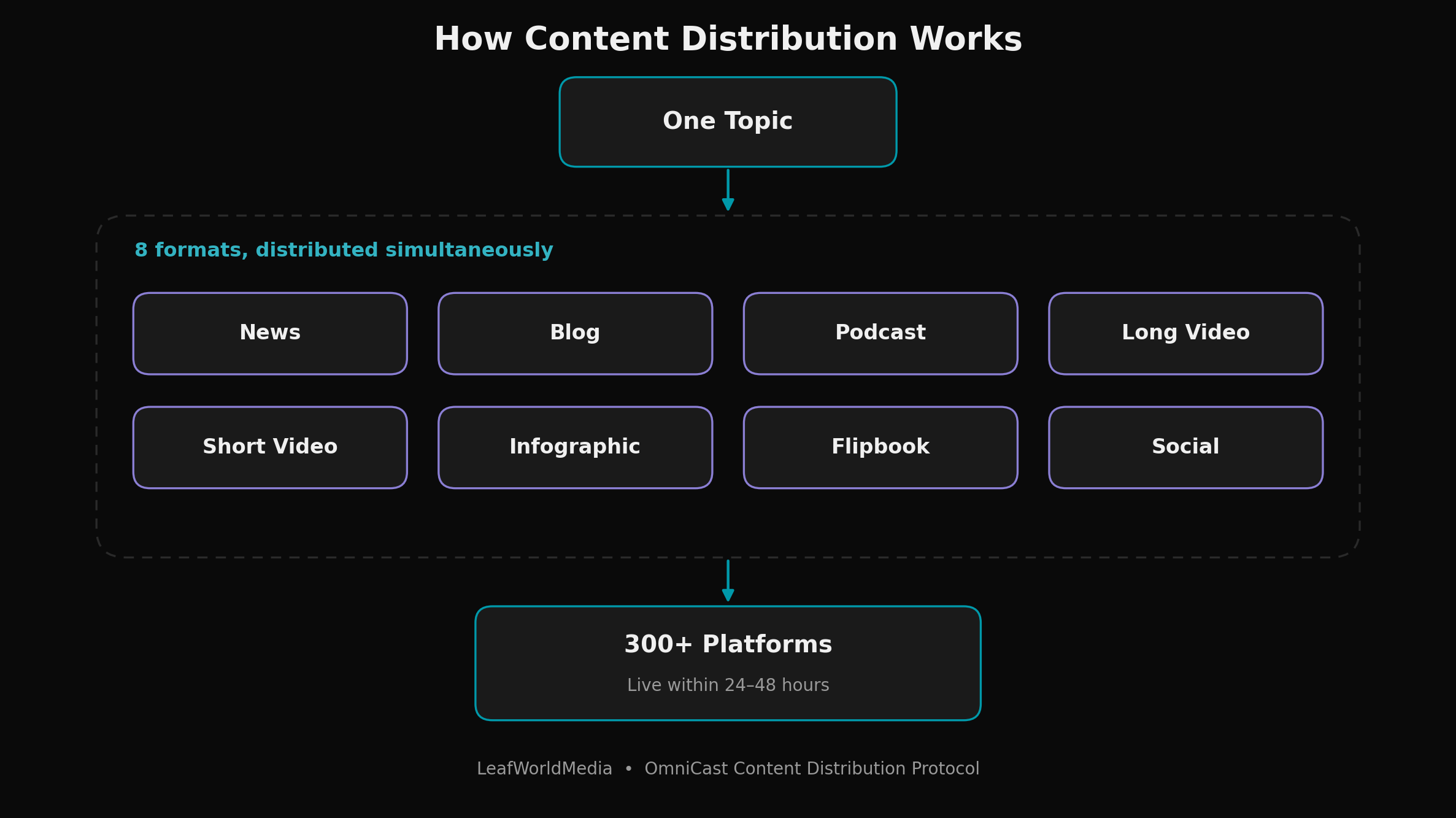
One topic becomes eight formats, distributed everywhere at once.
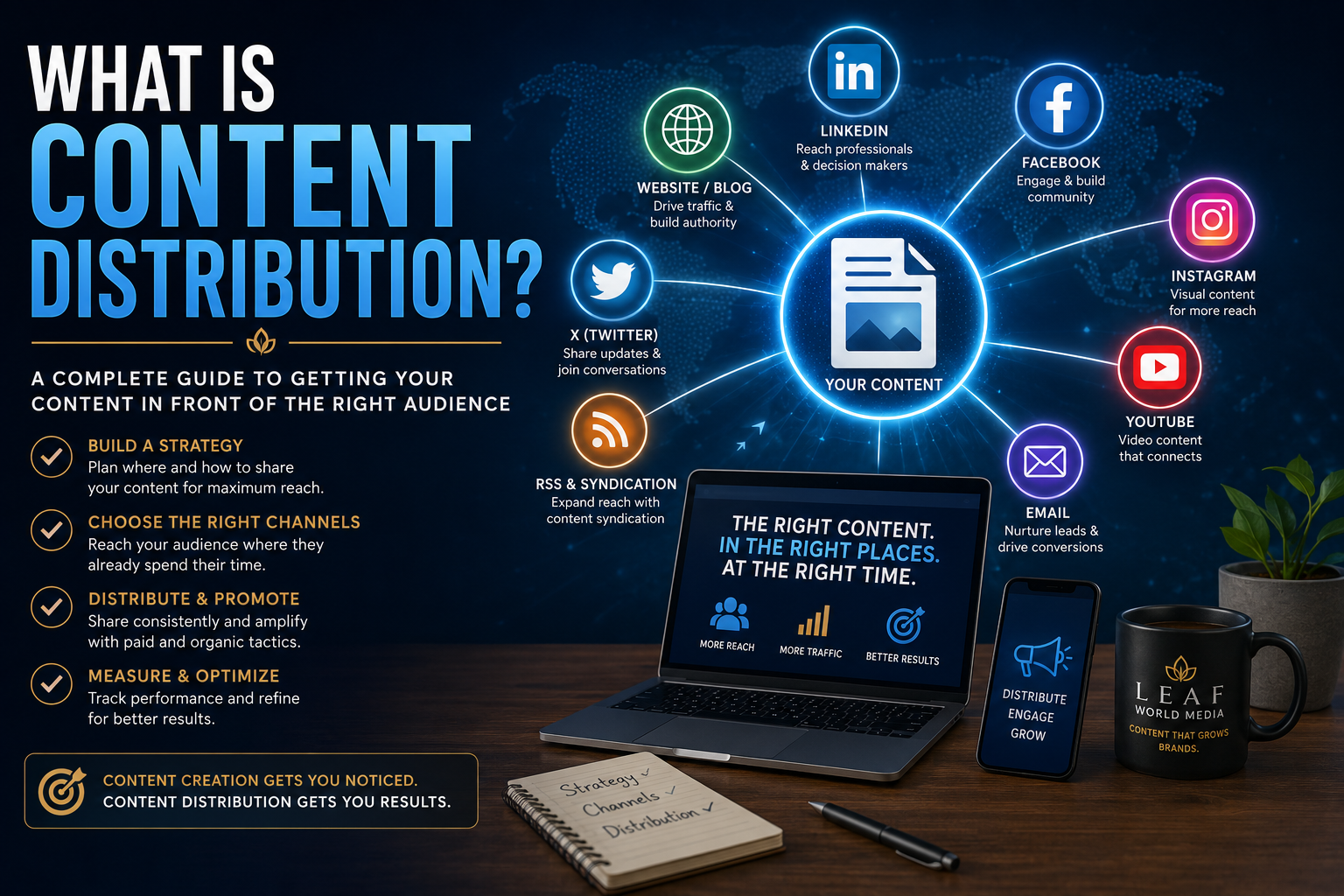
One topic, eight formats, hundreds of platforms — built for how AI engines actually discover brands.
How Distribution Actually Works, Step by Step
Understanding the mechanics helps make the concept concrete rather than abstract.
Start with one core topic or campaign idea
A single clear message or piece of news — a product launch, an educational topic, a milestone — becomes the foundation for everything that follows.
Adapt that topic into multiple formats
The same core message gets rewritten and reshaped into a press release, blog article, podcast script, video outline, infographic, and social posts — each tailored to how that specific format is actually consumed.
Distribute simultaneously across platforms
All formats are published across hundreds of platforms at once, rather than staggered over weeks, so the wave of mentions happens close together in time.
Placements go live and get indexed
As placements go live, search engines and AI crawlers begin indexing the content, building the web of mentions that reinforces entity recognition.
Results compound with consistency
A single campaign creates a short-term signal. Regular, ongoing campaigns are what build lasting authority — this is why consistency matters more than any single distribution event.
Common Mistakes That Undermine Distribution
Not all distribution efforts are equally effective. A few common mistakes tend to undercut the results businesses could otherwise get:
- Treating it as a one-time event. A single burst of placements fades in relevance over time. Ongoing, regular campaigns build compounding authority instead.
- Using identical content everywhere. Publishing the exact same text across every platform can look duplicative to search engines rather than like genuinely distinct, valuable content in each format.
- Ignoring format-fit. A press release written for a wire service reads very differently than a script written for a short-form video — content that isn’t adapted to its format tends to underperform wherever it lands.
- No clear core message. Distribution works best when every format reinforces the same core facts about the brand. Scattered, inconsistent messaging across formats weakens rather than strengthens entity recognition.
How to Measure Whether It’s Working
Distribution should be measurable, not just a leap of faith. A few concrete signals worth tracking over time:
- Placement reports — confirmation that content actually went live across the platforms it was distributed to, with links you can verify
- Referring domain growth — an increasing number of unique websites linking back to your site over time
- AI citation testing — periodically asking AI engines relevant questions in your industry to see whether your brand gets mentioned, ideally from an account without prior context about your business
- Search visibility over time — tracking whether your site shows up more often, and in more places, for relevant queries as campaigns accumulate
These signals build gradually rather than overnight — which is exactly why consistency, not a single campaign, is the real driver of long-term results.
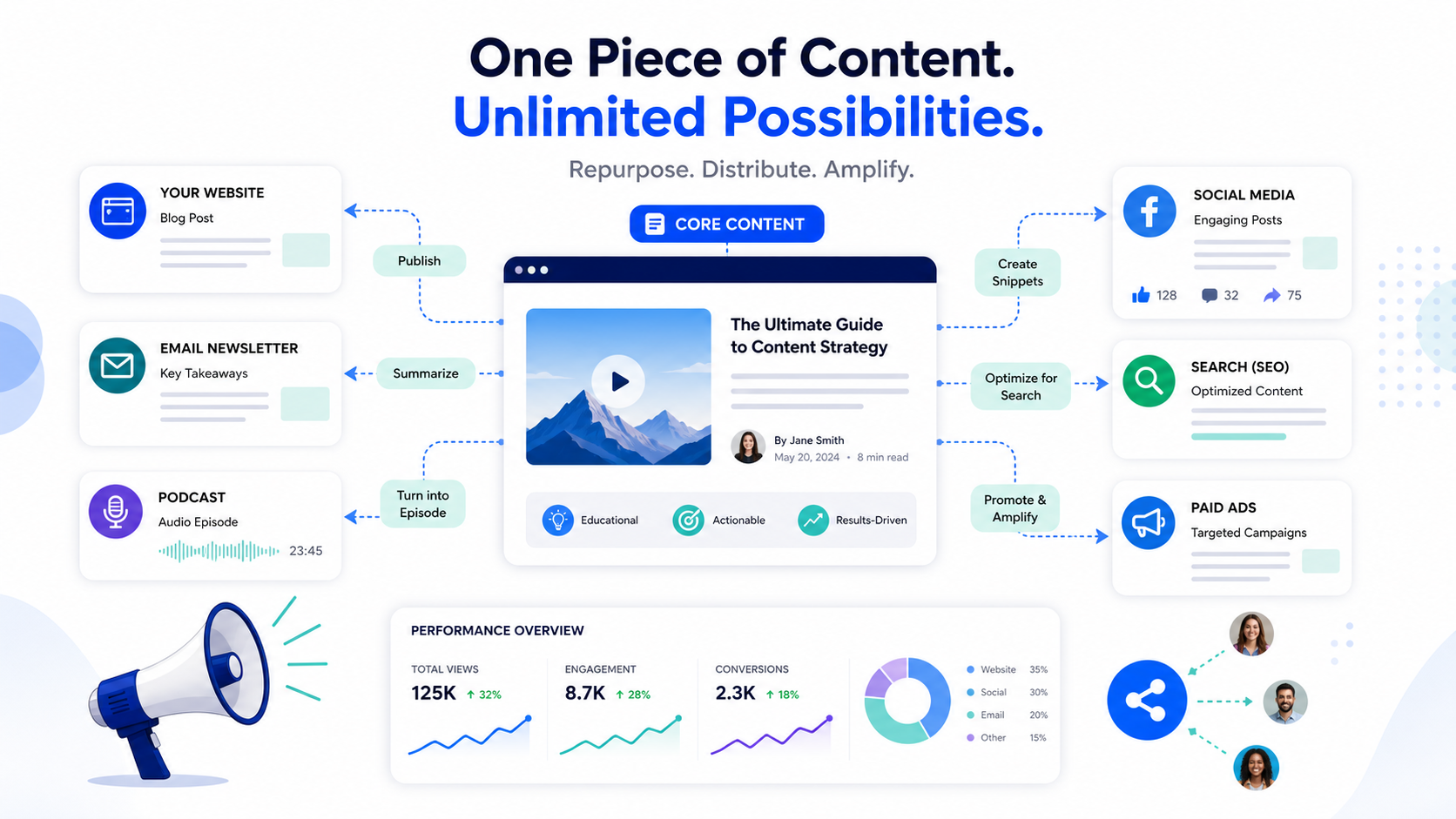
One piece of content, repurposed across every channel — and the results worth tracking along the way.
Frequently Asked Questions
Ready to distribute your next campaign?
OmniCast takes one topic and turns it into 8 content formats, distributed across 300+ platforms in 24–48 hours — starting at $799 per campaign, no contracts.
Start Your OmniCast Campaign




Leave a Reply