Google AI Mode is a conversational search experience inside Google that answers questions directly using AI-generated responses pulled from multiple sources at once — instead of returning a list of links to click. It now serves more than 1 billion monthly users, and the vast majority of those searches end without a single click to any website.
If your rankings haven’t moved but your traffic has dropped, this is very likely why — and it’s not a Google penalty. This guide explains exactly what changed, why your analytics look the way they do, and what’s actually worth doing about it.
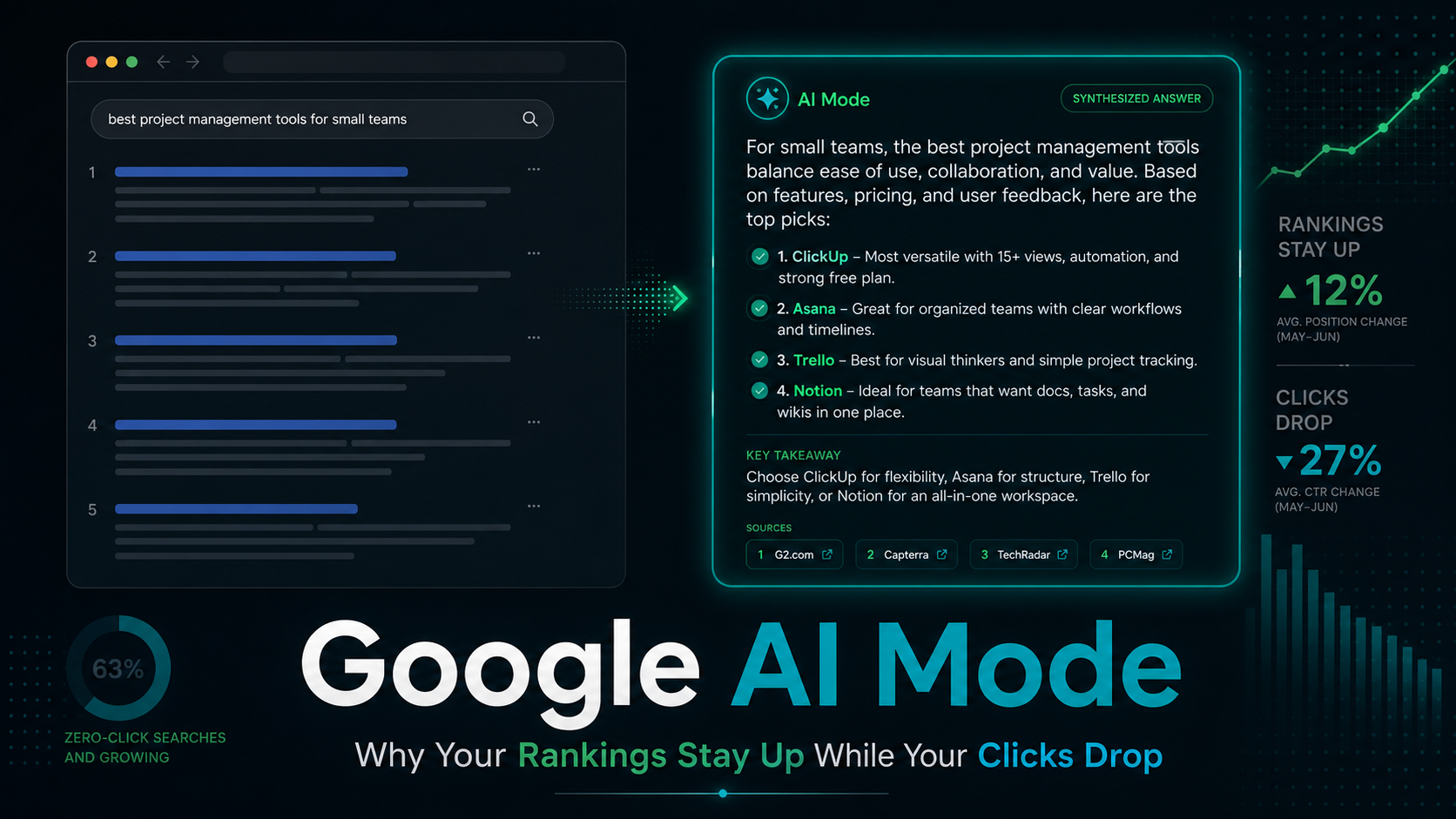
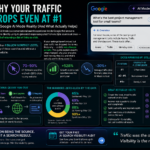
A side-by-side look at how Google AI Mode answers a query directly — while the page ranking #1 underneath it sees clicks fall.
In This Guide
What Is Google AI Mode, Exactly?
AI Mode is a separate, conversational tab inside Google Search — distinct from the “AI Overviews” summary box that sometimes appears above regular search results. Instead of returning a list of links, AI Mode has a back-and-forth conversation with the searcher and generates a synthesized answer pulled from multiple sources at once.
Google opened AI Mode to all U.S. users on May 20, 2025, at Google I/O, retiring the earlier sign-up requirement. By its I/O 2026 recap, Google reported AI Mode had surpassed 1 billion monthly users, with query volume more than doubling every quarter since launch.
The important distinction for a business owner: AI Overviews still show up inside traditional search results and sit alongside the ten blue links. AI Mode replaces that experience entirely with a conversational answer — meaning there often isn’t a results page to scroll past at all.
How AI Mode Actually Works: Query Fan-Out
The mechanism behind AI Mode is something Google calls query fan-out. When someone types a question into AI Mode, Google doesn’t just match it against one set of results. Instead, it breaks the question into several related sub-questions, runs all of them simultaneously against the live web, Google’s knowledge graph, and other data sources, then synthesizes everything into a single response.
Google’s own Head of Search, Elizabeth Reid, described it at I/O 2025: the system “recognizes when a question needs advanced reasoning” and calls on a custom version of Gemini to break the question into subtopics before researching them in parallel.
A simple example: someone searching “best hot tub for a small backyard” might silently fan out into sub-searches covering footprint dimensions, electrical requirements, delivery logistics, and price comparisons — pulling from several different pages across several different sites to build one answer, rather than sending the user to any single page.
Why Your Traffic Drops Even at #1
This is the part that confuses most business owners: Search Console shows steady or even improving rankings, but sessions are falling. Here’s what’s actually happening.
When AI Mode (or an AI Overview) answers a query directly on the results page, the user often gets what they need without ever clicking through — regardless of which page ranks #1 underneath that answer. Traditional ranking position and AI citation are no longer the same contest. Recent data shows the overlap between ranking in Google’s top 10 and actually being cited inside an AI-generated answer has fallen from roughly 75% in mid-2025 to somewhere between 17% and 38% in early 2026. In other words, ranking #1 and being the source AI actually quotes have become two different jobs.
So your rankings can hold steady in Search Console’s ranking report while your click-through rate quietly erodes underneath them, because the click was never guaranteed by the ranking to begin with — it depends on whether AI Mode chose to answer the question itself.
The Numbers: Zero-Click by the Data
A few figures worth knowing, pulled from the most recent 2026 industry data:
| Metric | Figure |
|---|---|
| AI Mode searches ending with no click | Up to 93% |
| Standard Google searches ending with no click (all types) | ~60-68% |
| Organic CTR when an AI Overview is present | Drops ~61-65% vs. no AI Overview |
| CTR boost for brands actually cited inside an AI answer | +35% (organic), +91% (paid) |
| “How-to” informational queries resolved by AI without a click | ~99.9% |
| “Buy X” / “best X for Y” commercial queries triggering AI Overviews | Only ~3-4% |
That last row matters most for a business like yours: purely informational “how does X work” queries are almost entirely absorbed by AI answers now, but commercial, comparison, and “best of” queries — the kind that actually drive a purchase — are far less likely to be fully answered by AI Mode alone. That’s a meaningful signal for where to focus content effort.
Does Ranking #1 Still Matter?
Yes — just not in the way it used to. Google’s AI Overviews and AI Mode heavily favor content that already ranks well in traditional search; strong backlinks and solid on-page SEO remain the foundation both systems pull from. Ranking #1 doesn’t guarantee an AI citation anymore, but ranking poorly makes a citation far less likely. Traditional SEO isn’t being replaced — it’s becoming the prerequisite for a second, separate goal: earning the citation itself.
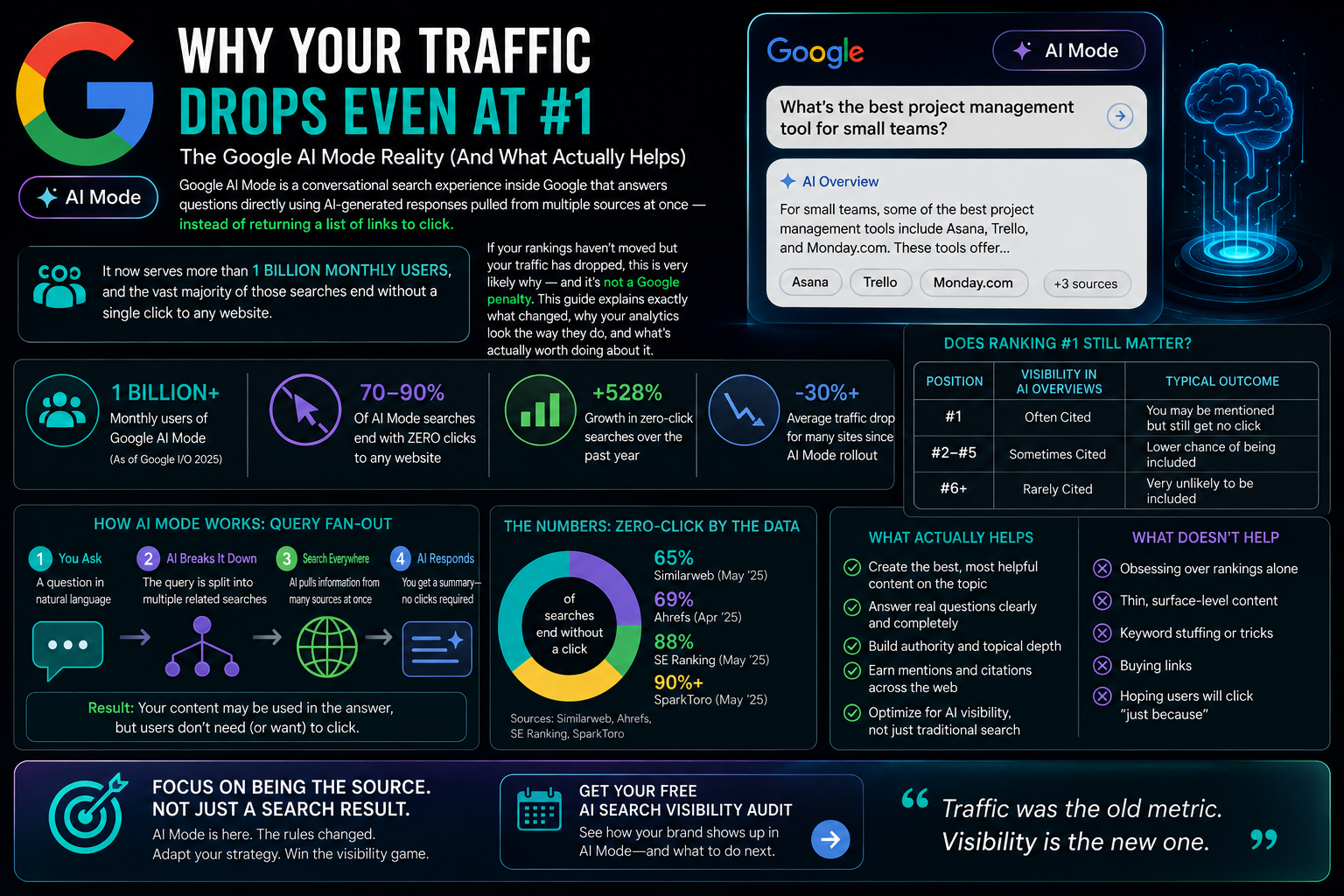
The full picture at a glance: how query fan-out works, what the zero-click data actually shows, and what helps vs. what doesn’t in AI Mode.
What to Actually Do About It
Based on the current research and what’s actually earning citations in 2026, here’s where effort pays off:
- Write extractable, self-contained answers. A 40–60 word block that directly and clearly answers one specific question, near the top of a section, is far more likely to get pulled into an AI-generated response than a paragraph that builds up to the answer slowly.
- Use real statistics with attribution. AI systems favor content with verifiable, sourced data over vague claims — roughly one concrete, attributed statistic every 150-200 words is a reasonable density target for a pillar post.
- Keep structured data current. FAQPage schema and clean Article markup remain part of the eligibility signal for both rich results and AI citation — not a guarantee, but part of the baseline.
- Build genuine topical depth, not thin pages. Comprehensive, long-form content that actually covers a topic’s sub-questions gives query fan-out more of your material to pull from across more of its generated sub-searches.
- Track visibility, not just clicks. Search Console impressions, brand-name search volume, and being cited by name in AI answers are now legitimate success metrics even when session counts don’t move.
- Double down where AI Mode is weaker. Commercial, comparison, and local queries are still far less likely to be fully absorbed by an AI answer than generic “how does X work” questions — that’s exactly where a business’s content budget should lean.
What Not to Waste Time On
A few reactions we’d steer you away from:
- Don’t panic-abandon SEO. The data is consistent on this point: traditional ranking factors, especially backlinks, remain the foundation AI systems build citations from. Nobody credible is recommending businesses stop optimizing for traditional search.
- Don’t obsess over one query type. A single informational post losing clicks to an AI Overview isn’t a crisis on its own — it’s expected. The pattern to watch is aggregate visibility and citation trend, not any one keyword’s session count.
- Don’t chase every new “GEO” tactic uncritically. This space is moving fast and full of unverified claims. Stick to fundamentals that are consistently confirmed across multiple independent sources — genuine depth, real data, clean structure — rather than one-off tricks.
Want your brand to be the one AI Mode actually cites?
OmniCast builds the multi-format authority signals AI engines look for before you get cited — not just ranked.
See How OmniCast Works →Frequently Asked Questions
What’s the difference between Google AI Mode and AI Overviews?
AI Overviews are AI-generated summaries that appear above traditional search results, alongside the normal list of links. AI Mode is a separate, fully conversational tab that replaces the results page entirely with a synthesized, back-and-forth answer. Both use the same underlying query fan-out technique, but AI Mode has a much higher rate of ending a search with no click at all.
Why did my traffic drop if my Google rankings haven’t changed?
Ranking position and being cited inside an AI-generated answer are no longer the same thing. AI Mode can fully answer a searcher’s question using content pulled from several sources at once, meaning the user never needs to click through to the page that technically ranks #1 underneath that AI answer.
Is traditional SEO dead because of AI Mode?
No. AI Overviews and AI Mode are shown to favor content that already performs well in traditional search — backlinks and solid on-page SEO remain foundational. What’s changed is that ranking well is now a prerequisite for a citation, not a guarantee of one.
What is query fan-out?
Query fan-out is the technique Google’s AI Mode uses to answer complex questions. Instead of matching a search to one set of results, it breaks the question into several related sub-questions, searches for each one in parallel, and combines the strongest results into a single synthesized answer.
Which types of searches are least affected by AI Mode?
Purely informational “how does X work” queries are resolved by AI answers at extremely high rates. Commercial and comparison queries — “best X for Y,” “buy X,” pricing comparisons — trigger full AI answers far less often, making them a more resilient area to focus content and SEO effort on.
How can a small business get cited inside AI Mode’s answers?
The consistent factors across current research are genuine topical depth, real statistics with clear attribution, extractable answer blocks near the top of sections, accurate structured data (like FAQPage schema), and a strong existing SEO foundation. There’s no shortcut that replaces those fundamentals.
Should I stop tracking website traffic as a success metric?
Not entirely, but it shouldn’t be your only metric anymore. Search Console impressions, branded search volume, and citations by name inside AI answers are increasingly legitimate indicators of marketing performance, even in periods where raw session counts decline.



Leave a Reply