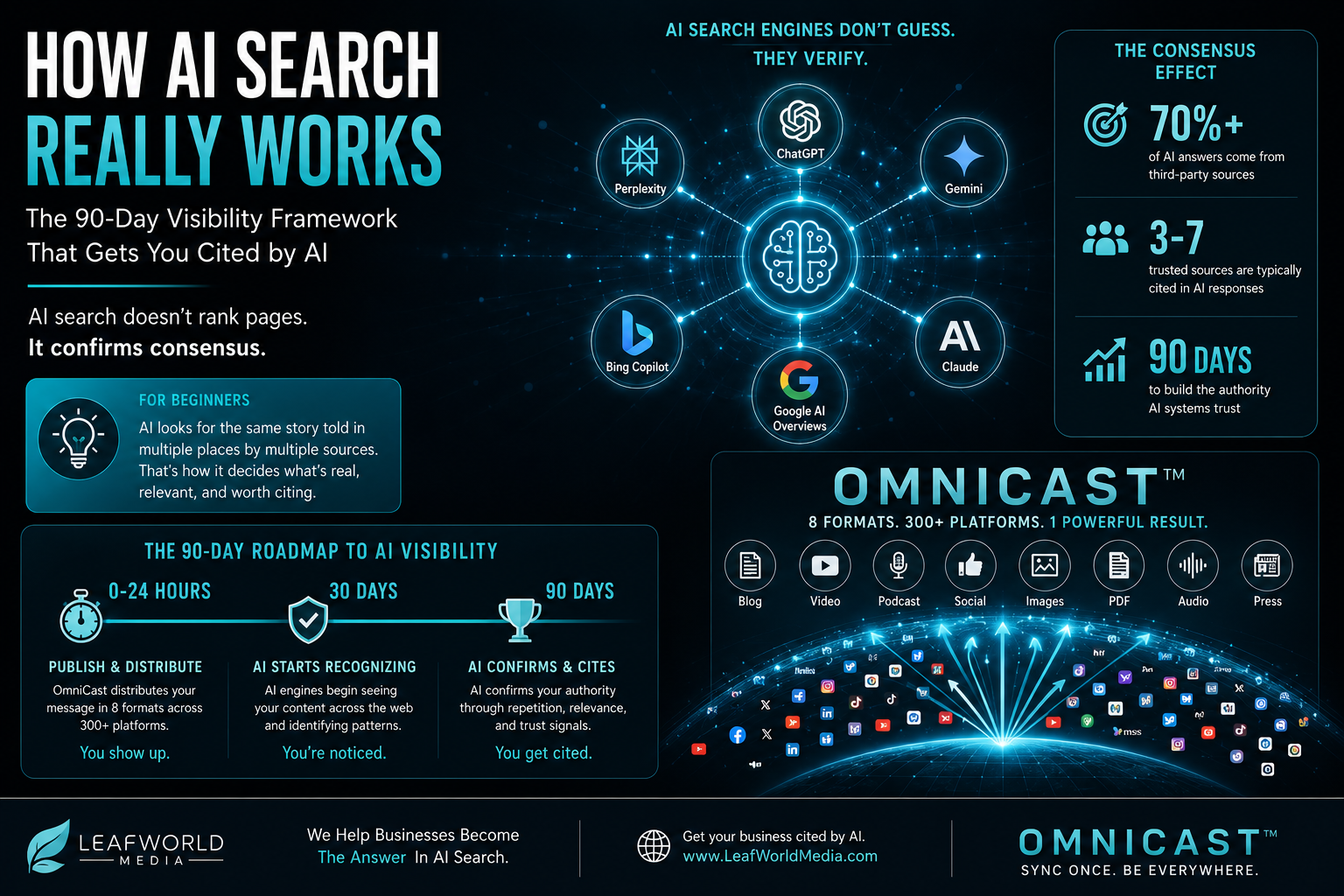
AI engines like ChatGPT, Perplexity, and Google Gemini build brand authority from multi-platform consensus signals — not single-source claims. The speed at which your brand appears in their answers depends on how fast you build that consensus.
If you’ve been wondering why your business isn’t showing up when someone asks ChatGPT or Perplexity about your industry — you’re asking the right question. This guide gives you the honest timeline, what actually controls speed, and what you can do to get there faster.
New to AI Search? Start Here
AI search ranking is different from Google ranking. When someone asks ChatGPT “who is the best [your service] in [your city]?” — ChatGPT gives one answer, not a list of 10 blue links. Getting into that answer is what Answer Engine Optimization (AEO) is about. And the timeline to get there is much faster than traditional SEO — if you know what you’re doing.
24–48hrTime for OmniCast content to reach 300+ platforms after submission
1–2 wksTypical time for AI engines to begin indexing new platform placements
60–90 daysFor consistent campaigns to produce reliable AI citations
3–6 moTraditional SEO timeline for comparable results — 3-6x slower
The Honest Answer: It Depends on 3 Things
There’s no single answer to how long it takes to rank in AI search — because AI engines don’t rank the way Google does. They don’t have a list you climb. Instead, they build a picture of which brands are credible authorities in a category based on what they find across the internet. Your timeline depends on how fast you can build that picture.

1. How Many Platforms Already Know You
A brand with presence on 5 platforms takes much longer than one on 300+. AI engines look for consistency across multiple independent sources before treating a brand as authoritative.

2. Whether Your Schema Is Correct
Structured data — Article, FAQ, Organization, LocalBusiness schema — tells AI engines exactly what your business does. Without it, they have to guess — and they often guess wrong.

3. How Consistently You Publish
One campaign gets you noticed. Consistent campaigns every week or two make you the obvious answer. AI engines build trust from patterns, not one-off appearances.

4. The Authority of Your Sources
A mention on AP News or USA Today carries dramatically more weight than a mention on an unknown blog. AI engines weight sources by their own authority level.
The AI Search Ranking Timeline
Here’s what a realistic progression looks like when you’re actively building AI authority — not just waiting and hoping.
Content Distributed to 300+ Platforms
Your first
OmniCast campaign goes live. 8 content formats — news articles, podcasts, videos, infographics, slideshows, social posts — distributed simultaneously. AI engines start encountering your brand across platforms they already trust.
AI Engines Begin Indexing Your Placements
ChatGPT, Perplexity, and Google Gemini crawl the platforms your content appeared on. They start associating your brand name with the topic you targeted. You’re being noticed — not yet recommended.
First AI Citations Begin Appearing
In a clean incognito search, you start seeing your brand mentioned when asking AI engines about your category. Usually indirect at first — “companies like X include…” — before becoming direct recommendations.
Consistent Citations Across Multiple AI Engines
With consistent bi-weekly or weekly campaigns running, your brand appears reliably across ChatGPT, Perplexity, and Google AI Overviews. Domain authority starts climbing as backlinks from 300+ platforms compound.
Category Authority — You Become the Default Answer
AI engines stop occasionally mentioning you and start defaulting to you. When someone asks about your category, your brand is the answer — not one of several. Google rankings also begin improving as domain authority crosses key thresholds. See our
bundle packages for the fastest path to this stage.
AI Search vs Traditional SEO — The Speed Difference
The reason AI search optimization is worth prioritizing right now is the speed advantage. Traditional SEO is a 6–12 month game. AI search — done correctly with synchronized multi-platform distribution — produces measurable results in weeks.
| Factor | AI Search (AEO) | Traditional SEO |
|---|
| First results visible | 1–2 weeks | 3–6 months |
| Consistent citations | 60–90 days | 6–12 months |
| What you’re competing for | One answer slot | Page 1 of 10 results |
| Key ranking signal | Multi-platform consensus | Backlinks + keywords |
| Content formats needed | 8 formats simultaneously | 1 blog post at a time |
| Early mover advantage | Very high — window open now | Low — market saturated |
The window is still open. Most businesses haven’t started optimizing for AI search yet. The brands that establish authority now — while the competition is still figuring out what AEO even means — will be extraordinarily difficult to displace later. This is the same opportunity early SEO adopters had in 2005.
What Slows You Down — And How to Fix It
Problem: Publishing on one platform only
If your only content is your own website, AI engines have one source telling them you’re credible — yourself. That’s like submitting your own reference letter. AI engines need to see independent third-party sources saying the same thing simultaneously.
Fix: OmniCast distributes one campaign across 300+ platforms in 24 hours — creating the independent consensus signal AI engines require.
Problem: No structured data on your website
Without proper schema markup — Article, FAQ, Organization, LocalBusiness — AI engines have to interpret your site through inference. This slows recognition and increases the chance they get your business category wrong.
Fix: Implement complete schema markup across all key pages. This is the foundation that makes everything else work faster. See what LeafWorldMedia does to build this for clients.
Problem: Inconsistent publishing cadence
Running one campaign and waiting is the most common mistake. AI engines build trust from patterns. A brand publishing consistently every week for 3 months signals stability and authority. A brand that published once in January and once in June signals nothing.
Fix: Commit to a weekly or bi-weekly OmniCast cadence for a minimum of 90 days. The compounding effect after 90 days is dramatically different from where you start.
Problem: Targeting the wrong topics
AI engines answer questions. If your content doesn’t map to the questions your buyers are actually asking AI engines, you won’t appear in those answers — even if your content is excellent.
Fix: Research what your buyers ask ChatGPT and Perplexity, then create content that directly answers those questions. LeafWorldMedia’s AEO bundle packages include this research as part of the done-for-you service.
How to Get There Faster
The fastest path to AI search citations combines three things:
1. Schema foundation — complete, correct structured data so AI engines can read your entity clearly.
2. Synchronized multi-platform distribution — OmniCast campaigns running consistently every 1–2 weeks, building consensus across 300+ platforms.
3. Authority source placements — getting on USA Today, AP News, and Business Insider through the Big 6 upgrade dramatically accelerates the timeline because AI engines weight these as primary citation sources.
Businesses that combine all three consistently see AI citations within 2–4 weeks and category authority within 60–90 days. Businesses doing only one or two take significantly longer — or plateau without ever becoming the default answer.
Frequently Asked Questions
How long does it take to show up in ChatGPT? +
With active
Answer Engine Optimization using synchronized multi-platform distribution, most businesses begin seeing ChatGPT citations within 1–4 weeks of their first campaign. Consistent citations across multiple query types typically appear within 60–90 days of maintaining a weekly or bi-weekly campaign cadence.
Is AI search ranking faster than Google SEO? +
Yes — significantly faster. Traditional Google SEO typically requires 3–12 months to produce meaningful results. AI search optimization, done correctly with
multi-platform content distribution, produces measurable citations in 1–4 weeks. Google ranks based on accumulated backlink authority built over months. AI engines look for consistent multi-platform presence, which can be built in days with the right distribution system.
What is the consensus signal and why do AI engines use it? +
The consensus signal is what AI engines use instead of Google’s PageRank system. When multiple independent, authoritative sources — news sites, podcasts, YouTube videos, social platforms — all describe a brand the same way at the same time, AI engines treat that as verified truth. A single website claiming authority means nothing. Three hundred independent platforms saying the same thing is a consensus signal AI engines trust and cite.
Does having good schema markup help me rank in AI search faster? +
Yes — significantly. Proper structured data (Article, FAQ, Organization, LocalBusiness schema) acts as a direct instruction set for AI engines, telling them exactly what your business does, who it serves, and where it operates. Without schema, AI engines have to infer this information — which takes longer and is less accurate. Schema is the foundation that makes all other AEO efforts work faster.
What is OmniCast and how does it speed up AI search ranking? +
OmniCast is LeafWorldMedia’s proprietary content distribution protocol. It transforms one topic brief into 8 professional content formats distributed simultaneously across 300+ high-authority platforms within 24–48 hours — creating the multi-platform consensus signal AI engines require to verify and cite a brand, in a fraction of the time it would take to build that presence manually.
How do I test if I’m showing up in AI search results? +
Open a clean incognito browser window — one with no history of your business — and ask ChatGPT, Perplexity, and Google Gemini questions about your industry category. For example: “Who is the best [your service] in [your city]?” or “What companies offer [your service]?” If your brand appears unprompted in those answers, you have AI search citations. If not, your AEO work is still in progress.
How long to rank in AI search with OmniCast specifically? +
With a single
OmniCast campaign — first citations typically appear within 1–2 weeks as AI engines index the 300+ platform placements. With consistent weekly campaigns — category authority typically develops within 60–90 days. With the
Authority Stack bundle including Big 6 placements on USA Today and AP News — the timeline accelerates because AI engines treat those sources as primary citation references.

Jerry Vaiana
Founder & CEO — LeafWorldMedia LLC
Jerry founded LeafWorldMedia in 2022 and developed the OmniCast protocol to solve the exact problem this post covers — getting businesses cited by AI engines faster than traditional SEO allows. Based in Staten Island, NY, LeafWorldMedia serves businesses nationwide.
Ready to Start Showing Up in AI Search?
One OmniCast campaign — 8 formats, 300+ platforms, 24 hours — starts building your AI citation authority immediately.
Start Your OmniCast Campaign — $799 →




Leave a Reply