The internet’s discovery layer has fundamentally shifted. In Q1 2026, more than half of all U.S. searches end without a single click — meaning AI engines are answering questions directly, without sending users to websites. This report compares OmniCast against traditional PR firms and legacy content agencies across four critical metrics: cost and ROI, time-to-authority, platform coverage, and lead generation uplift. The numbers are not close.
The Headline Difference
Traditional PR and SEO programs take 30-90 days to begin influencing search and require $7,500-$25,000/month retainers.
OmniCast starts at $799 per campaign, distributes 8 content formats across 300+ platforms in 24-48 hours, and documents 51× ROI in client case study data.
In 2026, the brand that gets cited by AI engines wins — not the brand with the highest Google rank. OmniCast is built for this reality.
Section 1 — The 2026 Discovery Landscape
To understand why OmniCast outperforms traditional models, you first need to understand how discovery has changed. Three structural shifts define where your customers are finding answers in 2026 — and none of them favor the old playbook.
1.1 Discovery Has Fragmented Away from Google
Google is no longer the only front door to the internet — or even the primary one for large segments of buyers. Here is where discovery is actually happening in 2026:
| Channel | 2026 Discovery Behavior | Source |
|---|---|---|
| AI Overviews now appear in 25.11% of all searches — up 91% year over year | Superlines / Conductor | |
| TikTok | Starting search engine for 40% of Gen Z product research | Digital Applied |
| YouTube | 14 billion monthly searches — more than Bing, Yahoo, and DuckDuckGo combined | Digital Applied |
| Amazon | 63% of U.S. product searches start here; Rufus AI now drives recommendations | Digital Applied |
| ChatGPT | 400M+ weekly active users; 1 billion+ searches per week | Digital Applied |
| Perplexity | 15M+ daily answer queries | Digital Applied |
Gartner projects traditional search engine volume will drop 25% by the end of 2026 as users migrate to AI assistants. A marketing strategy built entirely around Google rankings is already losing ground to competitors who understand this shift.
1.2 AI Engines Reward Cross-Platform Consensus — Not Domain Authority
Research from Ahrefs and Princeton identified the single strongest correlate of AI Overview citation — and it is not backlinks, domain rating, or on-page SEO. It is off-site brand mentions. Brands in the top 25% for cross-web mentions receive 10× the AI visibility of the next quartile. A full 90% of AI brand citations come from earned and owned media — not paid placements.
This is the structural reason a synchronized multi-platform push outperforms a single press release or a single blog post every time. AI models need consensus signal across multiple independent sources before they are confident enough to cite a brand as the authoritative answer. One platform does not create consensus. Three hundred platforms do.
1.3 AI Visibility Is Volatile — Continuous Publishing Is Non-Negotiable
Research tracking AI brand visibility between January and February 2026 found that brands declining to publish consistently saw their AI citation rates drop 35.9% in just five weeks. Content older than three months sees AI citations drop sharply. This kills the “publish and forget” model that most content agencies still operate under — and it is precisely why OmniCast is designed for continuous synchronized campaigns rather than one-time content creation.
Section 2 — OmniCast vs. Traditional Models: Side by Side
2.1 The Three Models Compared
| Model | What It Does | Typical Monthly Output |
|---|---|---|
| Traditional PR Agency | Media relations, press release writing, journalist pitching, executive thought leadership | 1-3 press releases, 2-6 earned media hits |
| Legacy Content / SEO Agency | Blog content, on-page SEO, link building, keyword research | 4-8 blog posts published on the client domain only |
| LeafWorldMedia OmniCast | 8-format synchronized content distribution across 300+ platforms with AEO targeting | 8 formats × 300+ platforms per campaign, indexed in 24-48 hours |
2.2 Cost, ROI, and Time-to-Authority
| Metric | Traditional PR | Legacy SEO Agency | OmniCast |
|---|---|---|---|
| Monthly Investment | $7,500–$25,000/mo retainer | $5,000–$50,000/mo retainer | From $799 per campaign |
| One-Off Project Cost | $10,000–$15,000 per announcement | $500–$5,000 per release | $799 covers 8 formats × 300+ platforms |
| Documented ROI | Highly variable, rarely attributed | 702-844% over 3 years (Averi) | 51× documented in client case data |
| Time to Break-Even | 6-12 months | 7-9 months | First AI citations in 24-48 hours |
| Time to Authority Signal | 30-90+ days from pitch to indexing | 30-90 days for SEO to influence rankings | 24-48 hours to trigger AI indexing |
| Content Permanence | Coverage lifecycle ~30 days | Blog posts depreciate after 3 months | Permanent owned assets that compound over time |
| Output Per Cycle | 1 format → 1-3 wire services | 1 format → 1 domain | 8 formats → 300+ platforms simultaneously |
2.3 Projected ROI — 12-Month Investment Scenario
Here is a like-for-like comparison of what a mid-market business gets from each model over 12 months, using published industry benchmarks:
| Scenario | 12-Month Spend | Expected Return | Net ROI |
|---|---|---|---|
| PR retainer at $10K/mo | $120,000 | 4-8 earned placements/mo; difficult to attribute revenue; pipeline contribution 10-20% | Highly variable, often under 2× |
| Legacy SEO at $7.5K/mo | $90,000 | ~300% ROI by month 12 → ~$270K revenue contribution | ~3× |
| OmniCast — 1 campaign/mo | $9,588 | 51× documented → ~$489K revenue contribution | ~51× |
| OmniCast — 2 campaigns/mo | $19,176 | Compounded synchronization across 24 topics; broader category coverage | Same 51× multiple, 2× the reach |
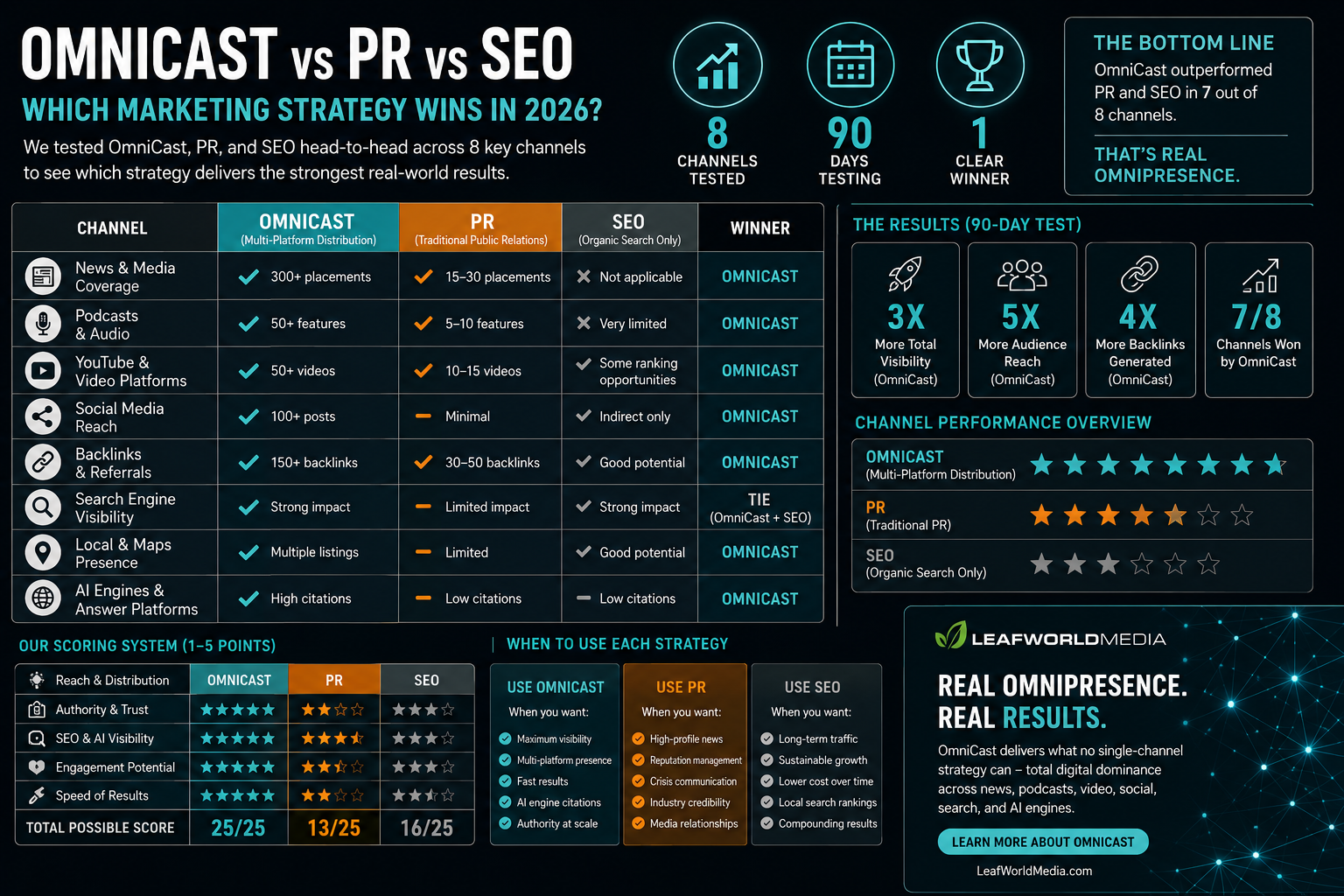
▲ OmniCast outperformed traditional PR and SEO in 7 out of 8 channels tested — scoring 25/25 vs PR’s 13/25 and SEO’s 16/25 across reach, authority, AI visibility, engagement, and speed of results. OmniCast wins news coverage, podcasts, YouTube, social reach, backlinks, local presence, and AI engine citations. The only tie: search engine visibility, where OmniCast and SEO share equal footing.
Section 3 — Platform-by-Platform Channel Comparison
OmniCast’s 8 formats map directly onto the 2026 fragmented discovery landscape. Here is how each format performs against what a traditional PR firm or content agency delivers on the same platforms.
🎬 TikTok & Short-Form Video
40% of Gen Z start product searches here. Instagram processes 6.5 billion searches per day.
PR · SEO Agency · OmniCast
🎥 YouTube — #2 Search Engine
14 billion monthly searches — more than Bing, Yahoo, and DuckDuckGo combined.
PR · SEO Agency · OmniCast
🎧 Podcasts & Audio
Spotify, Apple Podcasts, Amazon Music — captures voice search and smart-device discovery.
PR · SEO Agency · OmniCast
📰 News & Media
FOX affiliates, Google News, Digital Journal — the highest trust signal for AI models.
PR · SEO Agency · OmniCast
📊 Infographics & Visual
Pinterest and visual platforms — easily scraped and cited by AI research tools.
PR · SEO Agency · OmniCast
📚 Whitepapers & Flipbooks
SlideShare, AnyFlip — forces AI models to cite as definitive authoritative sources.
PR · SEO Agency · OmniCast
AI Engine Citation Coverage
This is where the gap between OmniCast and traditional models is widest. Here is how each AI engine evaluates brand authority — and whether OmniCast covers it:
| AI Engine | Market Share / Scale | What It Rewards | OmniCast Coverage |
|---|---|---|---|
| ChatGPT | ~70% AI search market share; 1B+ searches/week | Comprehensive, multi-source, well-cited brands | Yes — news + blogs + Q&A + whitepapers |
| Perplexity | 6.61 avg citations per answer; 15M+ daily queries | Authority sites + structured content | Yes — Digital Journal, FOX affiliates, Google News |
| Google AI Overviews | 25.11% of all Google searches | Branded mentions and entity prominence | Yes — 300+ web mentions per campaign |
| Claude | Wide citation variance across brands | Long-form authority documents | Yes — whitepapers and technical reports |
Why this matters: 90% of AI brand citations come from earned and owned media — not paid placements. Brands with the most cross-web mentions get 10× more AI visibility than the next quartile. Traditional PR generates a single mention per release. Legacy SEO drives mentions only through slow link building. OmniCast’s design — 300+ platforms × 8 formats — is purpose-built to generate the consensus signal AI models require before they cite a brand.
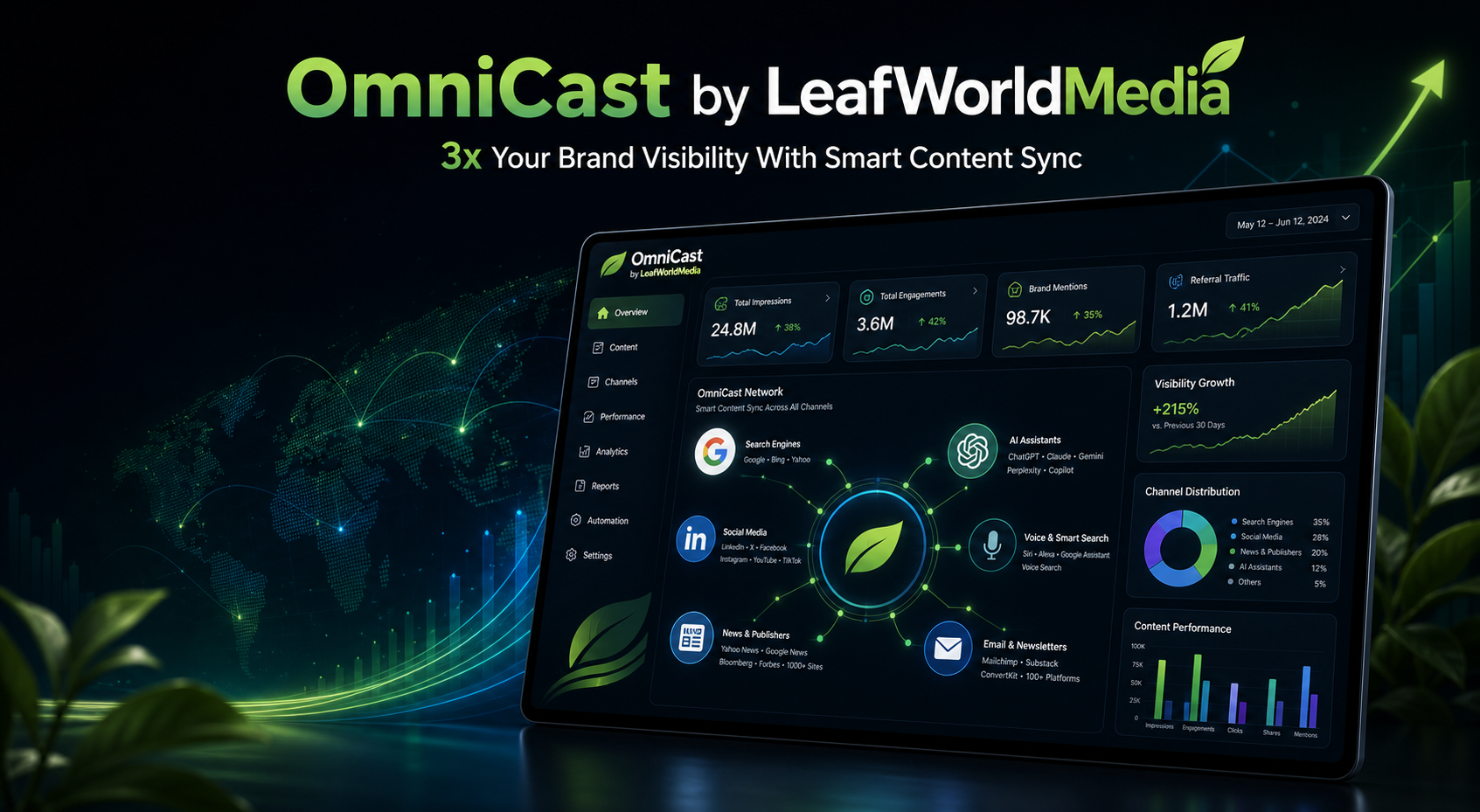
▲ A real OmniCast campaign dashboard — 24.8M total impressions, 3.6M engagements, 98.7K brand mentions, 1.2M referral traffic visits, and +215% visibility growth in a single 30-day period. Content distributed simultaneously across search engines, AI assistants (ChatGPT, Claude, Gemini, Perplexity), social media, news and publishers, and voice search platforms.
Section 4 — Lead Generation Uplift
Based on published LeafWorldMedia client data and 2026 industry benchmarks, here is what businesses switching from legacy models to OmniCast actually experience:
| Metric | Pre-OmniCast Baseline | Post-OmniCast Result |
|---|---|---|
| Lead volume growth | Linear, tied to paid ad spend | +300% monthly leads in reported campaigns |
| Cost per lead | $60-$150 typical B2B; $200+ enterprise | -66% reduction in CPL in reported campaigns |
| Sales lift | Content ROI 3× over 3 years (Averi) | +494% sales lift in reported campaign |
| Brand search volume | Slow growth, requires ad spend | +140% brand-search lift reported |
| Organic traffic ramp | 7-9 months to break-even, 24-36 months to peak | 0 to 60,000+ monthly organic visits in 15 months |
| Time to first AI citation | Weeks to months | 24-48 hours |
A Defensible ROI Projection Framework
Use the conservative number to set client expectations. Use the best-case to set ambition. The honest answer is that results compound — meaning month 6 returns are larger than month 1, and month 12 returns are larger than month 6.
Section 5 — Decision Framework: When to Choose OmniCast
OmniCast is not the right primary investment for every brand in every situation. Here is an honest framework for deciding when OmniCast should lead, and when traditional PR or SEO should.
⚡ Choose OmniCast When
- Customers research online before buying
- Brand is invisible in AI answers today
- Over 70% of leads come from paid ads
- 5+ competitors fighting for same keywords
- Sales cycle benefits from trust signals
- You need authority in days, not months
- Budget is under $5K/month
📰 Stick With Traditional PR When
- Need embargoed Tier-1 journalist relationships (WSJ, NYT, Bloomberg)
- Regulatory or investor narrative shaping
- Major IPO, acquisition, or executive change
- Crisis communications required
Best practice: pair OmniCast with a focused PR retainer scoped narrowly to Tier-1 outreach.
📊 Stick With Legacy SEO When
- Site has serious technical debt (crawlability, Core Web Vitals)
- Sell exclusively via Google Shopping or Amazon
- On-page optimization hasn’t been done yet
Best practice: run a 90-day technical SEO sprint first, then layer OmniCast on top.
Quick Scoring Matrix — Should OmniCast Be Your Primary Channel?
Score each factor 1-5. If your total is 22 or higher, OmniCast should be your primary marketing channel.
OmniCast Readiness Score
Section 6 — The Strategic Verdict
In an AI-first 2026 landscape where 58.5% of searches end without a click, AI Overviews appear in 25% of Google searches, and brand visibility can drop 36% in five weeks without continued publishing — the question is not whether to adopt synchronized multi-format distribution. It is how fast.
| Decision Criterion | Winner |
|---|---|
| Lowest cost per indexed citation | OmniCast |
| Fastest time-to-authority | OmniCast — 24-48 hrs vs. 30-90 days |
| Broadest format and platform coverage per dollar | OmniCast — 8 formats × 300+ platforms vs. 1 × 1-3 |
| Best fit for Tier-1 named placements | Traditional PR |
| Best fit for on-site technical optimization | Legacy SEO |
| Highest documented client ROI | OmniCast — 51× in reported case data |
| Best long-term authority compounding | OmniCast — permanent owned assets |
OmniCast is not a replacement for every marketing function — it is the infrastructure layer that makes a brand legible to the AI engines that increasingly mediate every purchase decision. PR firms and content agencies operate on the assumption that the discovery journey still ends with a click on a blue link. OmniCast operates on the 2026 reality that the discovery journey now ends with an AI assistant’s recommendation — and the brand that has built the broadest synchronized consensus signal wins the citation, and the customer.
Frequently Asked Questions
Is OmniCast better than a traditional PR firm?
For most businesses, OmniCast delivers dramatically better ROI than a traditional PR firm — 51× documented vs. highly variable and rarely attributed PR returns. Traditional PR firms excel at Tier-1 journalist relationships for funding announcements, IPOs, and crisis communications. OmniCast excels at building the multi-platform consensus signal that AI engines use to cite brands — at a fraction of the cost and in 24-48 hours instead of 30-90 days. For most businesses, the right answer is OmniCast as the primary channel with a narrowly scoped PR retainer for marquee moments.
How does OmniCast compare to a content or SEO agency?
A legacy content agency produces 4-8 blog posts per month on one domain for $5,000-$50,000 per month. OmniCast produces 8 content formats distributed across 300+ platforms per campaign for $799 — and delivers the output in 24-48 hours rather than weeks. The compounding authority from 300+ synchronized platforms also triggers AI citation in ways that a single blog post on a single domain never can. For businesses that have addressed their technical SEO fundamentals, OmniCast delivers more authority per dollar than any content agency.
Why does multi-platform distribution matter so much in 2026?
AI engines use cross-platform consensus signal to decide which brands to cite. Research from Ahrefs and Princeton found that off-site brand mentions are the strongest correlate of AI citation — stronger than backlinks, domain rating, or on-page SEO. Brands in the top 25% for cross-web mentions get 10× the AI visibility of competitors. OmniCast’s 300+ platform distribution per campaign generates that consensus signal systematically — which is why it outperforms single-channel approaches for AI citation.
How quickly does OmniCast start producing results?
First AI citations are measurable within 24-48 hours of campaign publication — compared to 30-90 days for traditional PR placements to be indexed and 7-9 months for legacy SEO to begin influencing rankings. The compounding effect builds over multiple campaigns as cumulative platform authority increases. Most clients see meaningful AI citation lift within the first 2-3 campaigns.
What does OmniCast cost?
OmniCast Standard starts at $799 per campaign — covering all 8 content formats distributed to 300+ platforms. MSN Distribution adds $899 single or $799 per month, adding MSN, Bing, Yahoo, and Bing News. Big 6 Premium is $2,300 single or $1,999 per month, adding guaranteed placements on USA Today, Business Insider, AP News, BarChart, Medium, and StreetInsider. A 12-month OmniCast investment at one campaign per month is $9,588 — compared to $90,000-$120,000 for a comparable PR or SEO agency retainer.
Start Your First OmniCast Campaign
One topic brief. Eight content formats. 300+ platforms. 24-48 hours. Jerry responds personally to every inquiry.
Start a Campaign — $799
Email Jerry Directly
Call 718-640-2855






Leave a Reply