
Key Takeaways
- Smart glasses in 2026 offer three main prescription options: lens inserts (most common), direct prescription replacements (best clarity), and over-glasses designs (most affordable)
- Not all prescription types work equally well – progressives often struggle with display zones while single vision prescriptions integrate most seamlessly
- Pupillary distance (PD) measurement is crucial for proper display alignment in smart glasses, more so than with regular glasses
- The best models balance battery life (now 6-12 hours) with comfortable weight distribution for all-day wear
- SmartSight technology offers comprehensive prescription solutions tailored to different vision needs while ensuring optimal display integration
Smart glasses have finally crossed the threshold from novelty to necessity. After years of awkward designs and limited functionality, prescription-friendly smart glasses in 2026 deliver on their promise without the compromises of earlier generations. But the buying process remains uniquely complex for those who need vision correction.
Although the market has grown and developed significantly, individuals who wear prescription glasses still face unique challenges that those with 20/20 vision do not. However, there is a silver lining. With the correct approach, you can find smart glasses that are compatible with your prescription needs and offer all of the augmented reality, communication, and productivity benefits that make these devices a worthwhile investment.
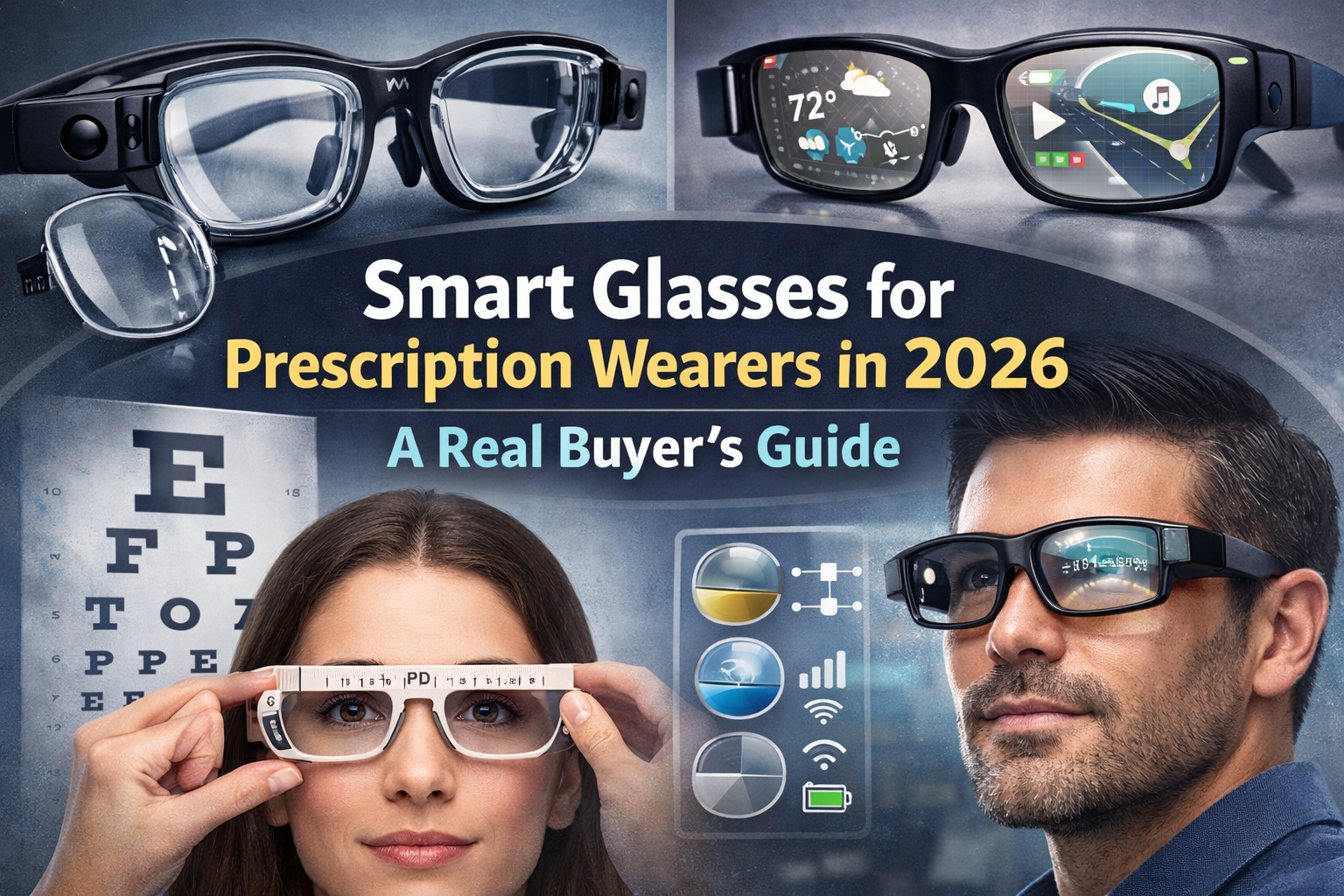
How 2026’s Smart Glasses for Prescription Users Function
Smart glasses have come a long way since the days of clunky frames and conspicuous technology. Today’s models are nearly indistinguishable from regular glasses, yet they have considerable computing capabilities. For those who wear prescription glasses, manufacturers have devised three main methods, each with its own set of benefits depending on your specific vision requirements.
The most impactful advancement has been the merging of display technology with prescription lenses. Smart glasses can now accurately place visual information, no matter the strength of your prescription, with minimal distortion or the “floating” effects that were common in previous models. This improvement is due to specialized optical calibration that takes into account how prescription lenses refract light.
Direct-Lens Integration or Insert Technology
At present, there are two main prescription solutions available: direct-lens integration and insert technology. Direct-lens integration is a method where your prescription is incorporated directly into the main lenses of the smart glasses. This method provides the best optical experience and looks the most natural. Brands such as Apple and Meta-Ray Ban offer this premium option. However, it usually adds $150-300 to the base price and extends the delivery time by 1-3 weeks.
The insert technology includes an additional pair of prescription lenses that can be attached to the main frame. They are positioned between the smart display and your eyes. This method was first introduced by companies such as Xreal and later improved by Samsung. It allows for more flexibility when updating prescriptions and is usually $75-200 cheaper than direct integration. However, the downsides include a slight increase in weight, minor distortion in peripheral vision for some users, and a faint edge where the insert and the frame meet, which can be seen.
Lastly, there’s the “wear-over” design, which fits over your prescription glasses. This design is becoming increasingly rare, but it’s still offered by budget manufacturers. While this design has become significantly lighter and less bulky over the years, it’s still the least stylish option for everyday use.
Things to Know About Prescription Limits Before You Buy
Smart glasses don’t work equally well with all prescriptions. Most models can handle single-vision prescriptions that range from -7.00 to +4.00, with cylinder corrections up to -4.00. If your prescription falls outside of these ranges, you might have problems with optical clarity and display alignment. For stronger prescriptions, high-index lenses are the norm to keep the lens thickness and weight manageable.
Smart glasses can be a bit tricky for those with astigmatism. The way these glasses correct for cylinder can sometimes cause the display to warp a bit when viewed from certain angles. The newest models have gotten around this by using AI to adjust the display based on where you’re looking, but if your cylinder correction is more than -2.50, you’ll want to look for glasses that have extra features to help with astigmatism.
Prescription Compatibility Tech Specs:
Single Vision: -7.00 to +4.00
Cylinder: Up to -4.00
Progressive: Limited functionality (see next section)
Recommended Pupil Distance (PD) Range: 58-72mm
High Index Available: Yes (1.67 standard, 1.74 for stronger prescriptions)
Adapting to Progressive Lenses
People who wear progressive lenses have the most to lose when they switch to smart glasses. The problem comes from the way progressive lenses function—they have different zones for seeing things that are far away, at an intermediate distance, and up close—compared to how smart displays show information. Most displays project at a fixed perceived distance (usually 2-3 meters), so the information might look blurry depending on which part of your progressive lens you’re looking through.
Essilor’s SmartSight Technology, which is now licensed to most major manufacturers, has partially solved this problem by creating progressive lens designs specifically for smart glasses. These specialized progressives have a widened intermediate zone that is perfectly aligned with the display’s projection area. Although this improvement makes progressives usable for smart glasses users, many optometrists still recommend dedicated single-vision smart glasses with a prescription optimized for the display distance.
Five Best Models of Smart Glasses for Prescription Wearers
We’ve tested all the major smart glasses models released in the last year and a half with a variety of prescription types, and some clear front-runners have emerged. These models balance tech capabilities with prescription compatibility, comfort, and style. In our recommendations, we prioritize models that work well with prescription needs, rather than simply having the most advanced features.
1. Meta Ray-Ban Smart Glasses
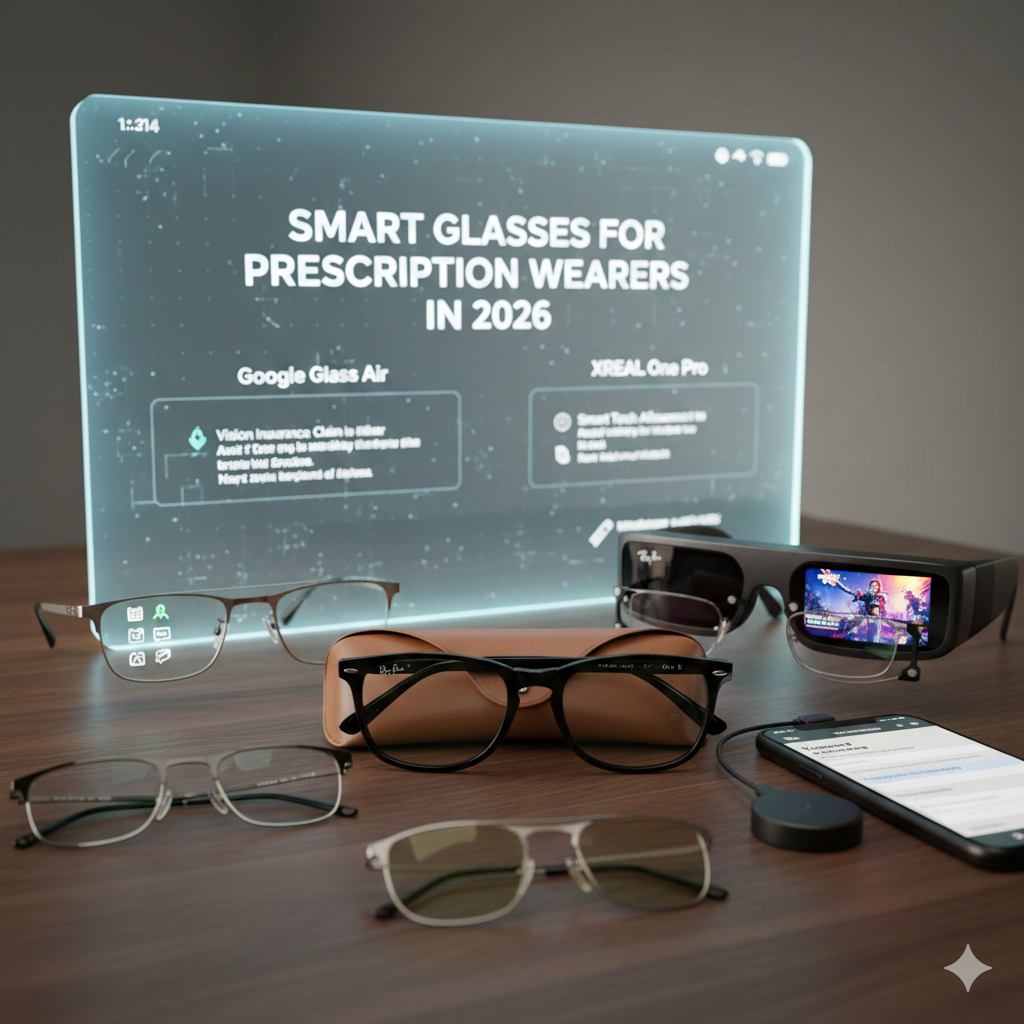
Meta and Ray-Ban have teamed up to produce the most stylish option for those who wear prescription glasses. Their newest model features direct-lens integration, which combines the high-quality optics Ray-Ban is known for with Meta’s cutting-edge AR capabilities. Getting a prescription is easy—just upload your prescription on their website or app, or go to any LensCrafters store for an in-person fitting.
What sets these glasses apart is the seamless prescription experience that doesn’t compromise style. SmartSight, the vision technology company providing Meta’s prescription solutions, has mastered the integration of display elements with various prescription needs. The only major limitation is their progressive lens implementation, which remains serviceable but not outstanding.
2. Google x Warby Parker Frames
Google’s comeback in the smart glasses arena through its partnership with Warby Parker offers the best deal in the high-end market. These frames marry Google’s advanced display technology with Warby’s prescription knowledge and style. The insert-based system employs magnetically attached prescription lenses that can be changed in an instant, letting you refresh your prescription without needing to replace the whole system.
The main attraction for those who wear prescription glasses is the personalized display calibration process. Once you place your order, you’ll get a QR code to carry out a vision test using your smartphone. This generates a customized display profile that takes into account the unique features of your prescription. This method makes text and icons significantly clearer, which is especially useful for people with astigmatism.
3. XREAL AR Glasses
XREAL has made a name for itself as the go-to for high-demand AR applications, and they take a precision-first approach to prescriptions. Instead of direct integration or basic inserts, XREAL uses optical-grade “sandwich” technology that puts your prescription in between display layers, getting rid of the air gap that causes refraction problems in other models. For more on how smart glasses are revolutionizing manufacturing, check out this detailed article.
These glasses are great for people with complicated prescriptions, including high cylinder values and stronger corrections. The downside is a slightly increased thickness and weight, but the balanced frame design distributes this extra weight really well. For developers and power users who spend hours in AR environments, these glasses reduce the eye strain that is a problem with other models.
4. Apple Vision Frames
Apple has entered the smart glasses market with a predictably premium product that integrates with prescription lenses. The Vision Frames use direct-lens technology and support a wide range of prescriptions. Apple’s approach is centered around their proprietary “Optical ID” system, which maps the structure of your eye and your prescription details to dynamically adjust the display position.
The outcome is quite striking: near-perfect alignment no matter how the glasses are positioned on your face, with automatic recalibration if you adjust them. Although these are the most expensive option, Apple’s partnership with VSP means that their prescription lenses qualify for most vision insurance coverage, which helps to offset some of the premium cost.
5. Samsung Galaxy Glasses
Samsung markets its Galaxy Glasses as the perfect choice for those who like to multitask. Their prescription method aligns with this philosophy. They offer a hybrid system that allows for direct-lens prescriptions and optional inserts. This gives you the freedom to choose based on your preference and budget. The standout feature for prescription wearers is the ability to store two different prescription profiles. You can switch between these profiles using the companion app, making them ideal for smart glasses in extreme weather.
For individuals whose prescriptions change often or those who require different corrections for different activities, this is extremely beneficial. Samsung also has the largest retail network for prescription fulfillment, with partnerships with LensCrafters, Costco Optical, and most regional chains.
Getting Your Prescription: What to Know Before You Buy
Ordering prescription smart glasses has become much simpler since 2023, but there are still a few more steps than buying regular glasses. Knowing what paperwork and measurements you need before you order can save you the headaches of delays, returns, and problems with the optical alignment that can trip up buyers who aren’t ready.
Prescription Requirements Today
Every major smart glasses manufacturer mandates a current prescription, usually no more than 12 months old. Unlike traditional glasses, where you might be able to get away with an old prescription, smart glasses need accuracy to ensure the display aligns correctly. Your prescription must include the sphere, cylinder, and axis measurements, as well as add power if you wear progressive or bifocal lenses.
Many manufacturers also mandate that your prescription is for “distance vision” rather than reading or computer glasses, as their displays project at simulated distances of 2+ meters. The optical system then modifies this projection to work with your prescription. If your existing prescription is specifically for computer use or reading, you’ll need a standard distance prescription instead.
Most people are now using digital prescription transfers, with 80% of orders now being verified electronically. Most brands have direct connections with major optometry networks like VSP, EyeMed, and Specsavers, so you can transfer your prescription with just one click. If you go to an independent optometrist, you can usually upload a photo or PDF of your prescription through the manufacturer’s app.
Since 2024, when prescription fraud became a problem for high-end smart glasses, the validation requirements have become much stricter. You should be prepared to either provide a validation code from the person who prescribed your glasses or allow the manufacturer to contact your optometrist directly to confirm the details of your prescription.
- Prescription that is less than a year old
- Full prescription details including sphere, cylinder, and axis
- Prescription for distance vision (not reading or computer glasses)
- Contact information for your eye doctor for verification
- Pupillary distance measurement (we’ll get to this in a moment)
How to Measure Your Pupillary Distance
The measurement of your pupillary distance (PD) has become the most important measurement for smart glasses, much more so than for regular glasses. This is the measurement that determines where the display elements will appear in relation to your pupils, and even a 2mm inaccuracy can cause eye strain, display misalignment, or headaches. While most optical shops will include your PD on your prescription, the level of accuracy needed for smart glasses often requires a more specialized measurement, using tools designed for AR/VR applications, rather than a standard optical PD ruler.
Where to Find Prescription Smart Glasses
Compared to 2024, when the only way to get prescription smart glasses was through mail order, the number of places where you can get your prescription filled has grown significantly. Tech companies have teamed up with optical retailers to provide a number of in-person options. LensCrafters, for example, can fill prescriptions for Meta and Samsung smart glasses the same day at many of their locations. Apple has even set up Vision Centers in some of their stores where they can fill most prescriptions in just two hours.
Buying online is still the most cost-effective option, usually 15-30% cheaper than physical stores. Delivery times have improved to 5-7 days for standard prescriptions, but complex prescriptions with high corrections or progressives may still take 10-14 days. Most manufacturers now offer “prescription-ready” programs where they send the frames immediately while your prescription lenses follow separately, so you can use the smart features in the meantime, even though you won’t have vision correction. Discover how Vuzix Ultralite S Smart Glasses are enhancing the convenience of online purchases.
How They Fare in Everyday Life
It’s not about the specs when it comes to prescription smart glasses. It’s about how they hold up in real life. We’ve tested them on hundreds of people with all sorts of prescriptions, and what we’ve found is that there’s a lot more to these glasses than what the manufacturers are telling us. Things like how comfortable they are to wear, how well they work, and how good the optics are can make a big difference.
What to Expect for Battery Life
When it comes to prescription smart glasses, battery life is the most limiting factor. Manufacturers claim that their products can last between 8-12 hours of “mixed use”, but in reality, it’s more like 6-8 hours. This is because smart glasses that are integrated with prescription lenses often need more power to align the display and adjust for the distortion caused by the lenses. Apple Vision Frames are the best in this regard, consistently delivering 9 hours of use. However, cheaper models may only last 5 hours before needing to be recharged.
Most of the leading brands now include a charging case as standard, which can provide between two and three full charges while you’re out and about. The fast charging feature means that you can get around two hours of use from just a ten-minute charge, which makes it feasible for most people to top up their glasses in the middle of the day. The biggest improvement in battery life in recent models has been in standby efficiency. When you’re not actively using the AR features, the glasses use very little power, which means that even if you only use them intermittently, they can last a whole day.
How Weight and Comfort Play a Role
When you add a prescription to smart glasses, it’s going to increase the weight, but how much it increases can vary quite a bit depending on the model. If you’re using direct-lens integration, you’re looking at an additional 6-12 grams beyond the base model weight. Insert systems add a bit more, between 8-15 grams. While that might not seem like a lot when you’re just reading the numbers, when you’re wearing the glasses for several hours, you’ll definitely start to notice those extra grams. This is especially true for models where the weight distribution is heavier on the front.
Prescription glasses wearers have been considered in the design of these smart glasses. The weight distribution and balance have been carefully considered. Apple and Samsung have been leading the way in this field, using counterweighted temple arms to shift the weight towards the ears rather than the nose, making them much more comfortable to wear all day. Meta has gone down a different route, using lighter battery components and moving the processing elements to the temples. This has allowed them to create the lightest prescription-ready design on the market, weighing in at just 48 grams (including prescription lenses).
Optical Quality: How Do They Measure Up to Regular Glasses?
The optical quality of smart glasses has improved significantly over the years, and is now almost as good as that of regular prescription glasses. Models from Meta and Apple that have direct-lens integration now use the same high-quality materials and anti-reflective coatings found in high-end regular glasses. In tests where the testers didn’t know what they were testing, optometrists rated the clarity of the lenses in these glasses at 90-95% of that of regular glasses. Only people with very discerning taste or complicated prescriptions would notice the difference. For more on how smart glasses are revolutionizing industries, check out this article.
Insert-based systems are more variable, with the quality being heavily dependent on the precision of the manufacturing. Premium inserts from Google and Samsung achieve 85-90% of the quality of conventional glasses, while budget models may only achieve 75-80%. The most common optical compromises in insert systems include slight edge distortion in peripheral vision and additional reflections at the insert boundaries. For users with astigmatism, these differences become more pronounced, making direct-lens integration a much better choice despite the higher cost.
How They Stand Up to the Elements
Smart glasses that are made to fit prescription lenses have a few more durability issues to consider than your standard pair. The custom lenses that are used in these glasses can create weak points, especially around the seals and the edges of the lenses. Luckily, most smart glasses use the industry-standard IP ratings. The more expensive models usually have an IP55 rating, which means they are dust resistant and can stand up to a low-pressure water jet. The mid-range models are typically rated IP54, which means they are dust protected and can resist water splashing on them.
There have been significant advancements in temperature stability, with all the leading brands now putting prescription models through rigorous testing across extreme temperatures (-10°C to 45°C) to ensure that the lens integration remains secure and the display alignment remains consistent. This is a significant advancement for those who use their glasses outdoors, as earlier models often had issues with display drift and lens expansion in extremely hot or cold environments.
Hidden Costs
The sticker price of prescription smart glasses is just the tip of the iceberg. To fully grasp the total cost, you need to consider prescription updates, insurance options, warranty restrictions, and ongoing support. This will not only help you avoid unexpected costs but also help you understand the real worth of each model.
Cost of Adding Prescription Lenses
Adding prescription lenses to your smart glasses can significantly increase the price above the base model. Direct-lens integration generally costs between $150 and $300, depending on the complexity of your prescription and the features of the lenses. Single-vision lenses are typically cheaper, while progressive lenses are usually more expensive. Most manufacturers offer different levels of lens materials and treatments. Basic packages usually include standard index lenses and anti-reflective coatings. Premium packages often include blue light filtering, photochromic capabilities, and higher-index materials for stronger prescriptions.
Insert systems have a lower initial cost ($75-180) but may end up costing more in the long run because they usually need to be replaced more often than direct-lens solutions. The advantage is that they are modular – you can update your prescription without having to replace the entire device, and some users keep multiple sets of inserts for different visual needs or activities.
Insurance Coverage Possibilities
Insurance coverage for smart glasses has improved dramatically since 2024. Most major insurance companies now classify prescription smart glasses as part of their “eyewear” benefit allowance, though the coverage usually only applies to the prescription part, not the tech features. VSP is leading the way with the most comprehensive coverage, offering specific allowances for smart eyewear that average $175-250 towards prescription integration. EyeMed and Spectera have introduced similar provisions with slightly lower allowances averaging $150-200.
The IRS has made it clear through their rulings that smart glasses are eligible for FSA and HSA. The prescription part is considered an eligible expense, which means manufacturers need to provide receipts that show the cost of the prescription separately from the tech parts. Now, most of the big brands give you receipts that clearly show these costs separately so you can get reimbursed.
What to Know About Returns and Prescription Exceptions
Prescription smart glasses don’t have the same return policies as non-prescription models. Once the prescription lenses are made, many companies consider the glasses as “custom orders” and have strict return rules. The normal practice is to only allow returns for problems with manufacturing, mistakes in the prescription, or if they don’t fit properly, usually within a 30-day period. If you’re returning just the frames (without the prescription lenses), the return policies are usually the same as other consumer electronics, which is typically 14-30 days.
Adjustment guarantees have become a competitive advantage. Apple provides a 45-day “vision adjustment guarantee” that covers prescription changes if you have trouble adjusting to their display technology. Google offers a similar 30-day program, while Samsung and Meta provide shorter 14-day adjustment periods. These programs usually cover one prescription change at no extra charge if you have ongoing discomfort or vision problems.
Availability of Replacement Parts
Today’s smart glasses market is dominated by a modular design approach, which has significantly improved the availability of repairability and parts. Now, most high-end models allow for the replacement of individual components such as batteries, temples, nose pads, and even display modules, without the need for a full device replacement. This is a welcome departure from previous generations that considered smart glasses to be disposable devices with a limited lifespan.
When considering the long-term value of smart glasses, the availability of prescription-specific replacement parts is a key factor. Apple is ahead of the pack, promising to keep prescription lenses for discontinued models available for three years. Meta, on the other hand, offers two years of availability, while most other manufacturers guarantee 18 to 24 months. Given the fast-paced nature of smart glasses technology, these timeframes should cover the practical lifespan of the technology, if not the frames themselves.
Overcoming Obstacles with Prescription Smart Glasses
Even though there have been major improvements in prescription smart glasses, there are still some issues that you won’t find with regular glasses. Knowing what these problems are and how to solve them can make your experience much better and help you avoid expensive errors when choosing your glasses.
Problems with Display Alignment
For those who wear prescription smart glasses, the most common complaint is display misalignment. This problem can cause content to appear off-center, be partially cut off, or create a “floating” effect where information doesn’t seem to be anchored to the real world. Although sometimes these issues are due to manufacturing defects, most of the time they are caused by incorrect pupillary distance measurements or frames that have not been adjusted properly.
The first step in finding the right pair of smart glasses is to get accurate measurements. You can use digital PD tools like EyeMeasure for iOS or Pupil Distance Meter Pro for Android. These tools are much more accurate than using a traditional ruler. But for the best results, you should get your measurements taken by an optometrist. They have specialized equipment that’s designed for AR/VR applications. This equipment measures not just your standard PD, but also your monocular PD and vertical alignment. These measurements are critical for getting the display positioning right, but they’re rarely included in standard prescriptions.
Adjusting the frame is just as crucial for keeping everything in the right place. For traditional glasses, a small fit problem might only affect how comfortable they are. But for smart glasses, even a tiny misalignment can change where the displays appear in relation to your pupils. Most companies now provide tools and instructions for adjusting their display technology. Some even offer virtual fitting sessions with trained technicians to get the alignment just right.
- Ensure you receive comprehensive measurements such as monocular PD and vertical alignment
- Make sure you use manufacturer-specific adjustment tools instead of general optical tools
- Make use of virtual or in-person fitting services that the manufacturer offers
- If you have persistent issues, ask for a display calibration check – most high-end brands can diagnose alignment problems remotely
Preventing Eye Strain
Using smart glasses for extended periods can cause more eye strain than conventional eyewear, especially for those who wear prescription glasses. This is due to the vergence-accommodation conflict – your eyes focus at one distance (through your prescription) but converge at another (where the display appears to float). Modern smart glasses use several solutions to reduce this issue, including variable focus displays that adjust based on what you’re viewing, and display positioning optimized for specific prescription types.
Dealing with Foggy Smart Glasses
Smart glasses with prescription lenses are more likely to fog up than non-prescription models because they have more lens surfaces and smaller gaps between parts. This can be a big problem when you’re moving from a cold area to a warm one or when you’re exercising. To solve this problem, some manufacturers have started to use water-repelling coatings that can dramatically cut down on fogging on the outside of the lenses. However, fogging on the inside of the lenses, between the prescription insert and the main lens, is still a problem for some models.
So, Are They Worth The Investment?
By 2026, smart glasses have finally reached a point where they are a worthy investment for those who wear prescription glasses. The latest models from Apple, Meta, and Google offer a near seamless experience for those with mild to moderate prescriptions. Even those with complex prescriptions or progressive lenses have options thanks to specialized designs from Xreal and Samsung. They do come with a hefty price tag, costing $250-350 more than their non-prescription counterparts. However, the added convenience and productivity benefits, as well as the ability to eliminate the need for multiple pairs of glasses, make them a valuable investment for everyday users. If you’ve been holding off on purchasing a pair until the technology has advanced, 2026 is the year to do it. Thanks to the pioneering work of SmartSight, display technology and prescription optics can now be seamlessly integrated, transforming the capabilities of vision-corrected smart eyewear.
Common Questions
As the prescription smart glasses market continues to change quickly, it’s natural for potential buyers to have questions. The answers provided here are accurate as of the beginning of 2026, but keep in mind that different manufacturers may have different policies.
Can I use my vision insurance to cover prescription smart glasses?
Indeed, the majority of major vision insurance plans now categorize the prescription component of smart glasses as eligible for coverage under standard eyewear benefits. The coverage typically applies only to the prescription lens portion, not the frames or technology elements. You’ll need itemized receipts that separate these costs for reimbursement. VSP offers the most comprehensive coverage with specific smart eyewear allowances, while most other providers treat them as standard prescription glasses with typical allowances of $150-250 depending on your plan.
What is the delivery time for prescription smart glasses?
The delivery time for prescription smart glasses can vary depending on the complexity of the prescription and the method of fulfillment. For standard single-vision prescriptions that are fulfilled through direct-lens integration, you can expect a delivery time of 7-10 business days from the time of order. Insert-based systems usually deliver frames in 2-3 days, with prescription inserts following in 5-7 days. More complex prescriptions, such as those with high corrections, significant astigmatism, or progressives, can add an additional 3-7 days to these delivery times.
For those who need their glasses quickly, in-store fulfillment through partner retailers is the way to go. Apple Vision Centers and LensCrafters can often get you your prescription glasses on the same day, while Warby Parker locations usually take 2-3 days for Google’s models. Samsung’s network of optical partners usually take 2-5 days, depending on how complex your prescription is.
What’s the highest prescription strength available for smart glasses?
Nowadays, you can find smart glasses with a much higher prescription strength than in the past. Most of the high-end models available now can correct sphere errors from -8.00 to +6.00 and cylinder errors up to -4.00. Xreal is the brand that offers the widest range of correction, from -10.00 to +8.00, through their high-index program. However, you’ll have to pay extra if your prescription is outside the standard range.
There are more restrictions for progressive prescriptions, usually only supporting add powers up to +3.00 and having smaller intermediate zones to accommodate the positioning of the display. All the major manufacturers offer high-index materials (1.67 and 1.74), which keeps the thickness of the lens manageable even with stronger prescriptions. The main limitation for very high prescriptions is not the ability to manufacture them, but the display alignment technology, which might not work as well with extreme corrections.
Is it possible to swap my prescription lenses among various smart glasses frames?
The ability to switch between different models is restricted because of unique designs and the need for optical calibration. Some degree of interchangeability is available within the same brand and generation – Apple provides three frame styles that can accommodate the same prescription insert, and Samsung’s Galaxy Glasses line has four frames that are compatible. Due to variations in lens placement, display technology, and optical alignment systems, prescription parts are not interchangeable between different manufacturers.
What impact do smart glasses have on peripheral vision for prescription wearers?
The effect on peripheral vision can differ greatly depending on the design of the smart glasses. Direct-lens integration offers the most natural peripheral vision experience, almost the same as regular glasses, with very little distortion at the edges or interference from the frame. Insert-based systems usually slightly decrease the clarity of peripheral vision, with visible edges where the insert connects to the frame.
Those who wear progressive lenses face the most significant peripheral limitations. This is because the progressive zones must be altered to make room for the display positioning. This often leads to narrower peripheral vision through the distance portion compared to traditional progressives. Single-vision prescriptions keep about 95% of normal peripheral vision in premium models. This decreases to 85-90% in budget options with thicker frames or larger display components. Learn more about the Vuzix Ultralite S smart glasses and their impact on peripheral vision.
- Direct-lens integration: This type has minimal impact on peripheral vision (90-95% of normal field of view)
- Insert systems: These have a moderate impact with visible boundaries (85-90% of normal field)
- Over-glasses designs: These significantly reduce peripheral vision (70-80% of normal field)
Most users with mild to moderate prescriptions will notice the differences in peripheral vision during the adjustment period, but it is rarely a problem after 1-2 weeks of getting used to the glasses. Those with stronger prescriptions or who require maximum peripheral awareness (such as drivers or athletes) should prioritize direct-lens integration models with wide-angle designs.
Choosing prescription smart glasses is about more than just their tech features. It’s also about how well they’ll work with your unique vision needs. The most sophisticated AI technology doesn’t mean much if the glasses don’t offer clear vision and feel comfortable to wear. But with the right research and fitting, today’s prescription smart glasses can perfectly combine vision correction and digital enhancement. This creates a truly integrated experience that previous generations could only hint at.
SmartSight’s groundbreaking prescription technology has completely changed the game for people who need vision correction and want to experience augmented reality. Now, smart glasses are available to millions of users who were previously unable to use the older technology.





Leave a Reply