Multi-platform content distribution is no longer optional — but distributing content across multiple channels without measuring the return is simply digital busywork. The real challenge is understanding exactly what you are getting back from all that effort. This data-driven guide gives you the frameworks, metrics, and attribution models to measure and maximize your OmniCast ROI accurately.
Why Traditional ROI Metrics Fail Multi-Platform Distribution
The standard ROI formula — (Revenue minus Cost) divided by Cost — was designed for a simpler world where you ran an ad, tracked a phone number, and measured immediate responses. Multi-platform content journeys today involve multiple interactions across devices and channels, sometimes taking weeks or months before a conversion occurs. A potential customer might discover you through a LinkedIn post, research through your blog, subscribe via email, and convert after watching a YouTube video — all driven by one OmniCast campaign. Measuring only the last touchpoint misses the entire system that made the conversion possible.

Multi-platform content ROI compounds over time — each campaign builds on the last, creating authority signals that strengthen organic visibility, AI citation frequency, and direct traffic simultaneously.
Building Your Multi-Platform ROI Measurement Framework
Before measuring specific metrics, you need a comprehensive framework that connects your content distribution efforts to actual business results. This starts with associating each platform with specific stages in your customer journey — from awareness through consideration to conversion and retention.
The critical insight is that multi-platform content delivers compounding returns that simple metrics miss entirely. Each piece of content reinforces the others, building brand recognition, authority, and trust across channels simultaneously. Furthermore, OmniCast’s synchronized distribution creates a consensus signal that AI engines recognize — generating AI citation value that traditional attribution models were never designed to capture.
Step 1 — Identify the Right Metrics for Each Platform
Each platform plays a unique role in your distribution strategy and should be measured based on that role. Rather than applying the same metrics to all channels, match each platform to its primary function in the customer journey.
- Awareness platforms (social media, content syndication, news sites) — measure reach, engagement rate, and brand recall
- Consideration platforms (blog, email newsletter, YouTube) — measure time on page, return visits, and content downloads
- Conversion platforms (email, landing pages, webinars) — measure click-through rates, conversion rates, and cost per acquisition
- Authority platforms (Google News sites, podcasts, industry publications) — measure branded search volume growth and AI citation frequency
Step 2 — Set Up Cross-Platform Tracking
Strong tracking across all channels is the technical foundation of multi-platform ROI measurement. At minimum, implement Google Analytics 4 with event tracking and UTM parameters for all distributed content. For more advanced measurement, tools like Segment, Mixpanel, or HubSpot can unify customer data across platforms into a single view — showing how each person interacts with your content across every distribution channel.
Step 3 — Choose the Right Attribution Model
Attribution models assign conversion credit across multiple touchpoints. The model you choose significantly influences which platforms appear to deliver ROI — making this decision critical for multi-platform strategies.
| Attribution Model | How It Works | Best For |
|---|---|---|
| First-Touch | All credit to the discovery channel | Awareness-focused campaigns with simple conversion paths |
| Last-Touch | All credit to the final touchpoint | Direct response content with short consideration cycles |
| Linear | Equal credit across all touchpoints | Content journeys where each touchpoint has similar importance |
| Time-Decay | More credit to more recent touchpoints | When recent interactions deserve more weight |
| Position-Based | Emphasizes first and last touch with middle credit | Balanced approach recognizing both discovery and decision |
| Data-Driven | Dynamic weighting based on actual conversion patterns | Most accurate — requires significant conversion volume |
For most multi-platform content strategies, position-based or time-decay attribution provides the most balanced view. As you gather more data, move toward custom attribution models that reflect your specific audience journey patterns.
Step 4 — Set Realistic Measurement Timeframes
ROI timelines vary dramatically by platform. Email distribution typically shows measurable returns within days to weeks. Social platforms take 1–3 months to show significant business impact. SEO and content syndication take 3–6 months to show significant ROI. However, these slower channels often deliver the highest long-term returns — and abandoning them prematurely based on short-term data is one of the most common multi-platform measurement mistakes.
Platform-Specific ROI Metrics That Actually Matter
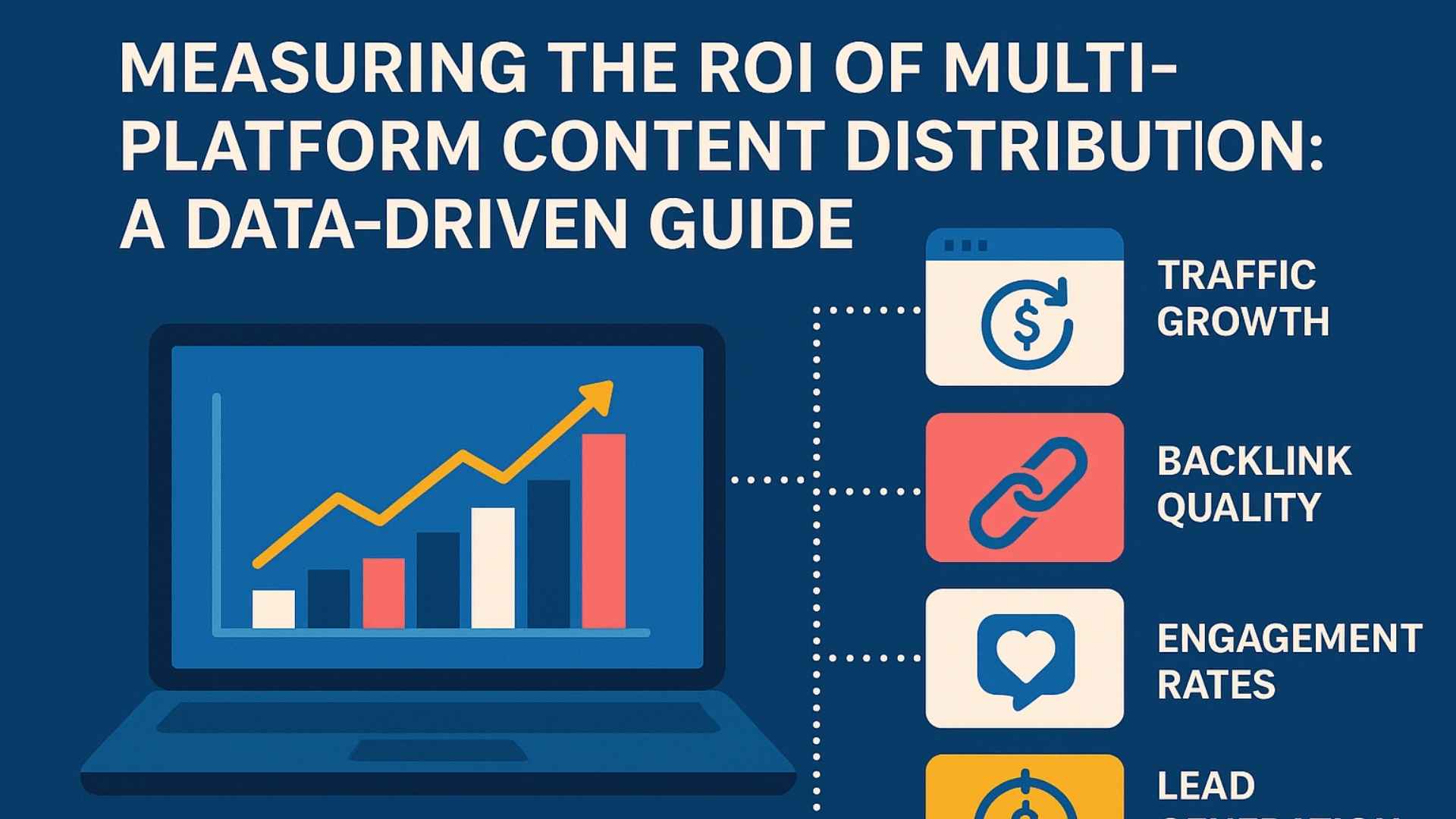
Generic metrics like impressions and views tell you almost nothing about business impact. Platform-specific KPIs aligned to each channel’s role in the customer journey reveal where your content is actually driving revenue.
Social Media — Look Past Vanity Metrics
Instead of likes and shares, measure click-through rates to your owned properties, conversion rates from social traffic, and cost per acquisition from social referrals. Advanced social ROI focuses on audience quality over quantity — what percentage of social followers eventually subscribe to your email list or become customers? Are your new followers matching your target customer profile? These metrics reveal whether your social distribution is building a valuable audience or simply inflating numbers.
Email Distribution — Engagement to Conversion Ratios
Email remains one of the highest-ROI distribution channels due to direct audience access. Beyond open and click rates, track the downstream conversion impact by following the complete funnel from email engagement through to purchase. Calculate revenue per email subscriber and customer lifetime value segmented by email acquisition source. The most accurate email ROI metric is the engagement-to-conversion ratio — how many engaged subscribers actually become customers.
Content Syndication — The Halo Effect
When distributing through third-party sites — Google News sites, industry publications, Medium — direct conversions may be modest. However, the most important metric is the halo effect: how syndicated content boosts performance on other channels. Do visitors who first discover your brand through syndicated content convert at higher rates when they later visit your website? Do they spend more? Track branded search volume growth and domain authority improvements alongside direct referral traffic. This indirect impact is the real ROI of OmniCast’s 300+ platform distribution network.
Video Platforms — Retention and Action Rates
For YouTube, TikTok, and LinkedIn video, view count is the least important metric. Audience retention — what percentage of viewers watch past the halfway point — indicates content quality and algorithm favorability. Videos performing above 40–60% retention consistently outperform in platform recommendations. Measure conversion actions: new subscribers, captured leads, and direct sales generated per video. Calculate ROI by weighing production costs against concrete business results.
Podcast Distribution — Attribution Workarounds
Podcast attribution is challenging because listeners often act later on different devices. Use dedicated landing pages, unique offer codes, or specialized URLs mentioned in episodes. Monitor direct traffic spikes and branded search increases that correlate with episode releases. Compare customer acquisition costs from podcast-sourced customers against other channels — and track their lifetime value. The most effective podcast distribution strategies consistently show lower acquisition costs and higher lifetime value than conventional channels.
Calculating the True Cost of Multi-Platform Distribution
Accurate ROI measurement requires accounting for all costs — not just direct content production. Many brands only consider creation costs while overlooking adaptation costs, distribution costs, and the most commonly forgotten expense: time.
Production vs. Adaptation Costs
Creating original content is only part of the investment. The bulk often comes from adapting content for different platforms — converting blog posts to social formats, transforming articles into video scripts, turning webinars into podcast episodes. Track creation and adaptation hours separately to understand your real investment per platform.
Smart multi-platform strategies begin with content pillars designed for efficient adaptation. This approach typically reduces total production costs by 30–50% compared to creating platform-specific content from scratch. OmniCast handles this entire process automatically from a single topic brief — eliminating adaptation costs entirely.
Hidden Time Costs
One of the most commonly overlooked expenses in multi-platform distribution is executive and subject matter expert time — hours that could be spent elsewhere. Include the hourly rates of everyone involved in content approval, review, and optimization when calculating ROI. Many brands discover they are over-investing in platforms that require significant hands-on management while delivering modest returns — a pattern that only becomes visible when time is properly monetized.
5 Strategies to Maximize Multi-Platform Content ROI
Strategy 1 — Repurpose Based on Performance Data
Rather than repurposing content haphazardly across platforms, use performance data to guide adaptation decisions. Identify which content pieces are converting at the highest rates regardless of platform, and prioritize those for cross-platform adaptation. Performance-guided repurposing typically delivers 3–5x higher ROI than indiscriminate distribution.
Strategy 2 — A/B Test Platform by Platform
Every platform has its own audience preferences and algorithm characteristics. Use systematic A/B testing to determine what actually works on each platform — testing headlines, images, content length, posting timing, and call-to-action placement in controlled experiments. Track these platform-specific insights centrally to guide future content creation. The brands that win in multi-platform distribution develop unique algorithm insights their competitors never discover.
| Platform | Top-Performing Content | ROI Impact |
|---|---|---|
| Text-based, personal narrative, industry insights | 2.3x higher engagement, 4.1x more qualified leads | |
| Carousel format, educational how-tos | 3.7x higher saves, 2.2x more profile visits | |
| Segmented content, single CTA, social proof | 1.8x higher click rate, 3.2x higher conversion rate | |
| YouTube | Keyword-optimized titles, value in first 30 seconds | 4.5x higher retention, 2.8x higher subscriber rate |
Strategy 3 — Plan Content Sequencing Strategically
The sequence in which your audience encounters your content across platforms significantly influences conversion rates. Analyze the customer journeys with the highest conversion rates and plan distribution timelines accordingly. Introduce content bridges — deliberate calls-to-action that direct audiences from one platform to another — creating intentional cross-platform journeys rather than isolated experiences. Viewing your multi-platform strategy as a cohesive system rather than separate channels consistently produces superior results.
Strategy 4 — Segment Your Audience for Targeted Distribution
Not every piece of content performs equally with every audience segment. Use platform analytics and CRM data to identify which content resonates most with which audience, then distribute accordingly. Targeted audience segmentation typically produces 40–70% higher engagement than broad distribution. Decision-makers often respond to data-driven content on LinkedIn and email. Technical implementers gravitate to YouTube and specialized forums. Early-stage prospects engage with educational content across multiple platforms. Late-stage prospects respond to comparison content and customer stories.
Strategy 5 — Optimize Conversion Paths by Platform Strength
Every platform excels at a different stage of the customer journey. Social media drives awareness. Email nurtures relationships. Webinars convert high-value prospects. Track the complete customer journey across all platforms, identify where audiences are lost in conversion transitions, and rework those bottlenecks with clearer calls-to-action. This systematic approach can improve conversion rates across platforms by 50–200% without increasing content investment.
Solving the Multi-Touch Attribution Challenge
The most significant obstacle in measuring multi-platform ROI is determining which platforms deserve credit for conversions. When potential customers engage with your content across multiple channels before converting, conventional analytics frequently misattribute value — assigning it entirely to either the first or last touchpoint while ignoring key intermediate interactions.
The Solution — Custom Attribution Models: The most accurate ROI measurement comes from custom attribution models designed around your specific content ecosystem. Analyze the conversion paths of your most valuable customers, identify platform interaction patterns that consistently lead to high-value conversions, and weight your attribution accordingly. Most brands find that 3–4 platform combinations drive the majority of their conversion value — and that identifying these combinations is where the biggest ROI improvements are found.
Building Your ROI Dashboard
Transforming raw multi-platform data into actionable insights requires a well-structured dashboard that highlights key trends and filters noise. Your ROI dashboard should link content performance directly to business results — showing stakeholders the value of your distribution strategy at a glance.
Structure your dashboard hierarchically — high-level business results (revenue, customer acquisition, retention) supported by platform-specific contribution metrics. Include both platform-specific metrics and cross-platform performance indicators such as content journey completion rates and multi-touch attribution results. Automate data collection with tools like Google Data Studio, Tableau, or Power BI to save 5–10 hours per week while improving reporting consistency and accuracy.
Frequently Asked Questions
How long does it take to see ROI from multi-platform content distribution?
The timeline varies significantly by platform and content type. Email distribution typically shows measurable returns within days to weeks. Social platforms generally take 1–3 months to show significant business impact. SEO and content syndication can take 3–6 months to show meaningful ROI. The key is establishing appropriate measurement windows for each platform rather than applying a one-size-fits-all timeline. OmniCast campaigns typically trigger AI indexing signals within 24–48 hours, with engagement metric improvements appearing within 30 days and lead generation impacts within 60–90 days.
Which attribution model works best for measuring multi-platform content ROI?
There is no single universal model for all multi-platform strategies. The most effective approach typically combines position-based attribution — which assigns significant credit to both the first and last touchpoints with some credit to middle interactions — with custom weighting based on your own customer journey analysis. As your measurement matures, move toward data-driven attribution that dynamically adjusts based on observed conversion patterns. Most brands find that 3–4 platform combinations drive the majority of their conversion value once proper attribution is in place.
How do I measure ROI when my content goals are not directly tied to revenue?
For non-revenue objectives like brand awareness or audience growth, establish proxy values that link these goals to business outcomes. Calculate the average value of an email subscriber over a defined period and use that figure to assign value to content that drives subscriptions. Calculate the average conversion rate from social followers to customers and use that to assign value to audience growth. This approach converts non-revenue metrics into monetary terms — enabling consistent ROI comparison across platforms with different primary objectives.
What is the minimum tracking setup needed for multi-platform measurement?
At minimum, implement Google Analytics 4 with proper UTM tagging on all distributed content, track conversions for key actions, and set up a basic CRM integration that connects marketing touchpoints to sales outcomes. This enables basic multi-platform attribution while collecting the essential data needed to calculate ROI. As your strategy matures, add tools like customer data platforms, heat mapping, and journey analysis software to build a more complete picture of cross-platform performance.
How often should I review and adjust my multi-platform content strategy based on ROI data?
Implement a layered review schedule. Review tactical metrics — engagement, traffic, conversions — weekly, making small adjustments to current distribution. Examine platform-level performance monthly, adjusting resource allocation as patterns emerge. Conduct a comprehensive ROI analysis quarterly, making significant strategic changes based on sustained performance trends. The most successful brands combine regular scheduled check-ins with performance alerts that flag significant changes requiring immediate attention — avoiding both knee-jerk reactions to normal fluctuations and slow responses to meaningful shifts.
How does OmniCast improve multi-platform content ROI?
OmniCast eliminates the primary cost driver in multi-platform distribution — the time and resources required to create, adapt, and distribute content across multiple channels manually. One topic brief becomes 8 professional content formats distributed across 300+ platforms within 24–48 hours, at a starting price of $799 per campaign. This dramatically reduces the cost side of the ROI equation while simultaneously increasing the return — through AI citation signals, diverse high-authority backlinks, branded search volume growth, and the compound authority that builds with each successive campaign.
What ROI benchmarks should I target for multi-platform content distribution?
Look for 15–30% of your audience engaging with your content across two or more platforms within a 30-day period as a sign your ecosystem is working. Target a 30–50% reduction in customer acquisition costs compared to single-channel strategies as your distribution system matures. LeafWorldMedia clients typically see a 40–70% increase in content ROI within the first 90 days of implementing proper measurement frameworks — primarily by identifying and eliminating underperforming distribution channels and reallocating those resources to their highest-ROI platforms.
Turn Your Content Distribution Into a Measurable Business Driver
OmniCast by LeafWorldMedia gives you synchronized distribution across 300+ platforms in 8 formats — with the permanent authority assets and AI citation signals that make every campaign compound on the last.
📞 718-640-2855 | 📧 Info@LeafWorldMedia.com | 🌐 LeafWorldMedia.llc






Leave a Reply