
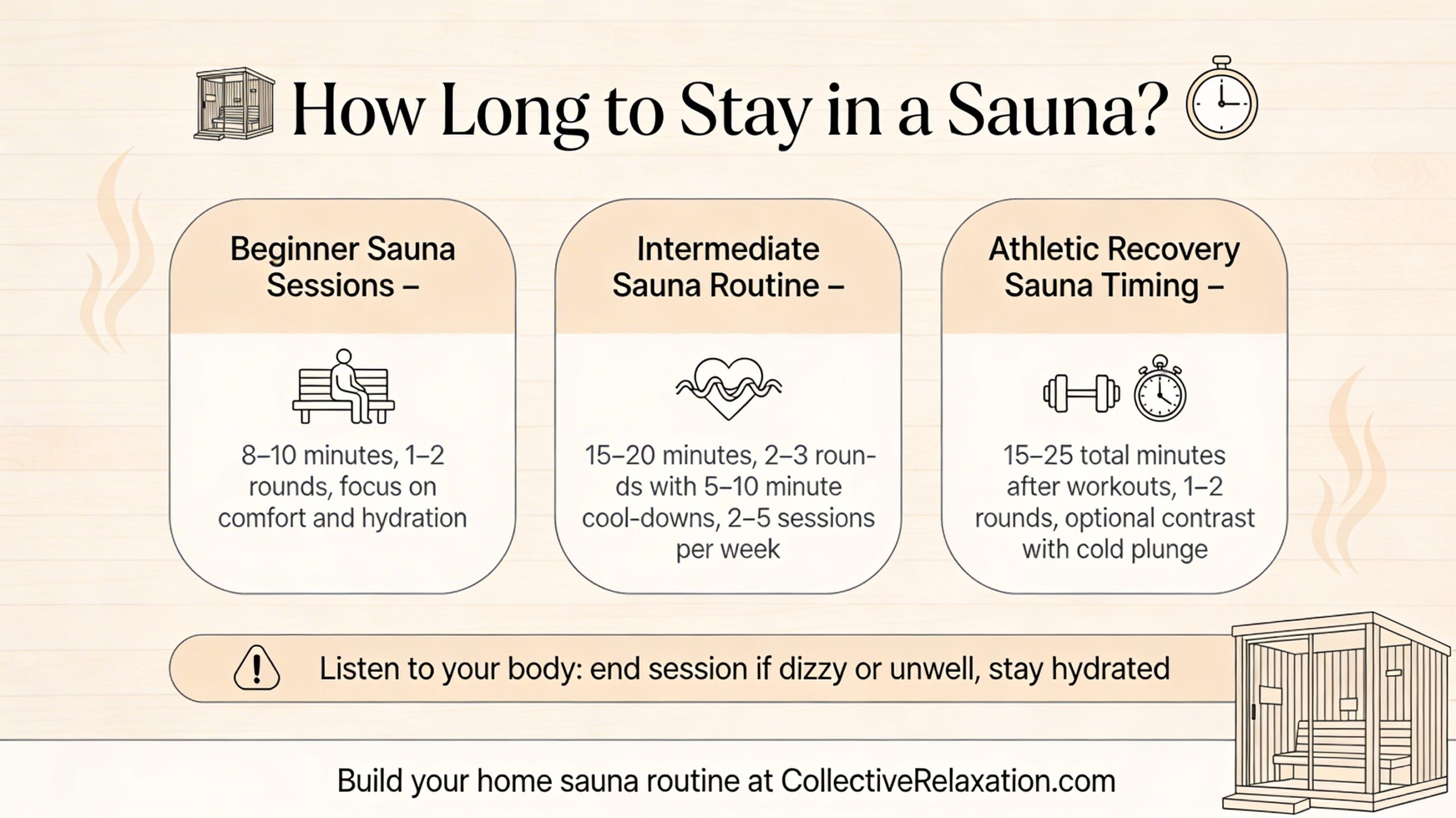
- If you’re new to saunas, start off with 5–10 minutes per session and gradually increase the time as your body adjusts to the heat.
- For most people, 10–20 minutes per sauna session is ideal, with 2–3 sessions separated by cooling periods for maximum benefit.
- Overstaying in a sauna can result in dehydration, dizziness, and overheating — more time does not always mean more benefit.
- The type of sauna you use changes how long you should stay — infrared saunas run cooler and often allow slightly longer sessions than traditional Finnish saunas.
- Consistency matters more than session length — regular shorter sessions deliver better long-term results than infrequent marathon sessions.
Getting sauna timing right is the difference between a powerful wellness tool and a health risk — and most people are doing it wrong in one direction or the other.
Figuring out how long to stay in a sauna can be a game-changer, whether you’re a newbie who just found out your gym has a sauna or you’re a wellness junkie building a dedicated home wellness routine. The heat exposure triggers real physiological responses — cardiovascular, hormonal, and muscular — but only when you get the timing right. Sunlighten, a leader in infrared sauna technology, emphasizes that session length is one of the most critical variables in getting consistent, measurable results from heat therapy.

Most People Don’t Use Saunas Correctly — Here’s How to Fix It
Go to any gym sauna and you’ll see two types of people: the one who runs out after five minutes and the one who’s been sitting there for 45. Neither approach is ideal. The first person barely taps into the benefits of heat therapy, while the second is pushing their body into a stress zone that hinders recovery rather than helping it.
Why You Shouldn’t Stay Too Long
Many people underestimate the danger of staying in a sauna for too long. When your core body temperature gets too high, your heart has to work harder to pump blood to your skin to cool you down. This can lead to dizziness, nausea, and even heat exhaustion if you’re not careful. Dehydration can make these problems worse, especially if you weren’t properly hydrated before you got in the sauna. To maintain a balanced home wellness routine, it’s crucial to monitor your sauna time carefully.
Most professionals agree that 20 minutes is the maximum time for a single sauna session, regardless of your level of experience. Even if you’re a seasoned sauna user who does multiple rounds, you should always take a break to cool down and rehydrate between sessions. This break is not just a suggestion — it’s a fundamental part of the process.
Why a Short Sauna Session Doesn’t Cut It
On the other hand, popping in for three minutes is just as bad. Your body needs time to increase its core temperature before it starts to react — your heart rate goes up, heat shock proteins are produced, and growth hormones are released — and these are the reasons why using a sauna is beneficial. Short, distracted sessions are basically like warm showers, minus the water.
Starting Out: Sauna Use for Beginners
For those who are just starting out with sauna use, the most crucial tip is to avoid pushing your limits too quickly. It’s important to remember that heat adaptation is a real phenomenon and your body needs time to build up its tolerance.
First-Time Users Should Aim for 5–10 Minutes
If you’re new to the sauna, aim to stay in for 5 to 10 minutes for your first few sessions. This isn’t because you can’t handle more time, but because your cardiovascular system, sweat response, and thermoregulation are all adjusting at the same time. Pushing too hard in the first week can lead to headaches, tiredness, and a negative experience with something that should be relaxing.
When starting out, limit yourself to just one round per session. Enter the sauna, let the heat do its thing, then exit and cool off with some room temperature water – avoid ice cold water as it could shock your system. After consistently doing short sessions for two to three weeks, your body will tell you when it’s ready for more.
How to Know When It’s Time to Leave the Sauna
Our bodies are excellent at letting us know when we’ve had enough heat — the issue is that many people disregard the initial signs and wait until their body is screaming at them to get out. Be on the lookout for these signs that it’s time to leave the sauna, and don’t treat them as obstacles to overcome:
- Feeling dizzy or as though the room is spinning
- Noticing a sudden decrease in sweat, despite the room being hot
- Experiencing a rapid or irregular heartbeat
- Feeling sick or discomfort in your stomach
- Experiencing a tingling sensation in your hands or feet
- Feeling cold, even though the room is hot (this is known as paradoxical chilling)
If you experience any of these symptoms, it’s time to get out of the sauna. The best thing to do is to cool down, rehydrate, and rest. You should not go back into the sauna until these symptoms have completely disappeared.
How to Organize Your Initial Weeks
A basic starting plan looks like this: explore a home wellness routine plan to set a strong foundation for your wellness journey.
| Week | Duration of Session | Number of Rounds per Visit | Frequency |
|---|---|---|---|
| Week 1 | 5 minutes | 1 round | 2 to 3 times per week |
| Week 2 | 7 to 8 minutes | 1 to 2 rounds | 2 to 3 times per week |
| Week 3 | 10 minutes | 2 rounds | 3 times per week |
| Week 4 | 10 to 15 minutes | 2 rounds | 3 to 4 times per week |
This slow and steady increase allows you to build up your heat tolerance without overtaxing your body. By the end of week four, most newbies are ready to confidently tackle intermediate session lengths.
Intermediate Sauna Timing: The Sweet Spot for Health Benefits
After a few weeks of regular sauna use, you’ll find that the 10–20 minute range is where the magic happens. This is the range where most research on the benefits of sauna use — such as improved cardiovascular health, muscle recovery, and stress hormone reduction — has been conducted.
At this point, the primary change is transitioning from single sessions to organized multiple sessions. Having two to three sessions with intentional rest periods in between significantly increases overall heat exposure while ensuring that each individual session is within a safe physiological range. Instead of viewing it as a single long sit, consider it as interval training for your cardiovascular system. For a comprehensive home wellness routine plan, incorporating sauna sessions can be an effective addition.
Finding the 10 to 20 Minute Balance
For those who have some experience, a good aim is 15 minutes per round. This is enough time to raise your core temperature and start producing heat shock proteins, but not so long that your body starts to compensate for the stress. Most people at this level do two full rounds each time they use the sauna, which adds up to between 25 and 35 minutes in total. If you’re interested in exploring alternative sauna options, consider reading about infrared sauna chromotherapy for a unique experience.
What’s the Ideal Number of Rounds per Session?
If you’ve been using the sauna for a while, you’ll probably find that two to three rounds per session is the perfect amount. Just one round doesn’t give you the full benefits of the heat, but if you stay in for four or more rounds, you risk getting too tired or dehydrated. Two rounds with a break in between is usually the safest and most effective way to use the sauna.
Don’t Underestimate the Importance of Rest Periods Between Rounds
Contrary to what you might think, the cooling period between sauna rounds is not just a break — it is an essential part of the process. When you step out and let your body cool down, you set off another round of physiological responses: your heart rate returns to normal, your body rehydrates, and your parasympathetic nervous system shifts, which enhances the overall recovery effect. For more insights on sauna usage, explore how long you should actually stay in a sauna.
Generally, you should take a 5 to 10-minute break between sauna sessions. During this time, you can hydrate, sit in peace, or take a lukewarm shower. One of the most frequent errors that sauna-goers make is to return to the sauna before their heart rate has normalized, which greatly reduces the benefits of the sauna. For those interested in enhancing their routine, you might consider incorporating a cold plunge during your break to further boost circulation and recovery.
Expert Sauna Protocols for Athletes
As an athlete or a seasoned sauna-goer, your body has become accustomed to the heat. This is due to repeated exposure that has conditioned your cardiovascular system, sweat response, and thermoregulation mechanisms. As a result, your body can handle the heat more efficiently, allowing you to endure slightly longer and more structured sessions.
However, more experience does not equate to unlimited time. Even the most elite athletes adhere to structured, round-based protocols, rather than enduring marathon-length single sessions. The aim at this level is precision: to target specific recovery outcomes with deliberate timing, rather than just enduring the heat for as long as possible.
For experienced users, a full session usually looks like this: starting with a warm-up phase, followed by a main heat session, and concluding with a cool-down period. To enhance your sauna experience, you might explore the benefits of infrared sauna chromotherapy as part of your routine.
Here’s a simple breakdown of a typical sauna session:
- Round 1: Spend 15-20 minutes in the sauna at full temperature.
- Rest: Take a 10-minute break. This should include active cooling and hydration.
- Round 2: Spend another 15-20 minutes in the sauna.
- Rest: Take another 10-minute break.
- Round 3 (optional): If you’re up for it, spend another 10-15 minutes in the sauna.
- Total active sauna time: You should spend a total of 40-55 minutes in the sauna across the entire session.
Wait 10-20 Minutes Before Using a Sauna After a Workout
Many people, even experienced athletes, make the mistake of going straight from a tough workout to the sauna. Right after a workout, your core temperature is already high, your cardiovascular system is working hard, and you’re low on fluids. Adding the intense heat of a sauna to this situation can cause dehydration and can make your heart rate go uncomfortably high. If you wait 10 to 20 minutes after your workout before going into the sauna, it gives your body a chance to start recovering before the heat of the sauna amplifies the recovery process.
Contrast Therapy: The Power of Heat and Cold for Recovery
Contrast therapy, which alternates between the heat of a sauna and cold immersion, has become a favorite advanced recovery technique for athletes. The back-and-forth constriction and dilation of blood vessels creates a pumping effect in the circulatory system. This effect speeds up the removal of metabolic waste and lessens muscle soreness. Here’s what a typical contrast therapy sequence might look like:
- 10–15 minutes in the sauna
- 2–3 minutes in a cold plunge or cold shower (around 50–60°F)
- Return to sauna for another 10–15 minutes
- Repeat for 2–3 full cycles
- Always end with cold to reduce inflammation before re-entering daily activity
The cold exposure portion should never be rushed. Two to three minutes in cold water is enough to trigger the desired vascular response without sending the body into a prolonged cold stress state.
Here’s a key point for athletes using contrast therapy: avoid this protocol right before a competition or intense workout. The heat and cold combination significantly calms the nervous system and decreases short-term explosive power output. Save contrast therapy for rest days or recovery periods after competitions.
Contrast therapy, when done right, can significantly speed up recovery time between intense training sessions. Many professional sports teams have now added structured sauna-cold cycles to their standard recovery procedures, specifically because the timing and temperature variables can be measured and repeated.
The Kind of Sauna You Use Can Influence Your Duration Inside
There’s no one-size-fits-all approach to saunas, and the kind you use will determine the length of each session. The temperature range, humidity level, and heat delivery method can all alter how your body reacts — and therefore how long you can stay inside without risking your health or losing the benefits.
Length of Traditional Finnish Sauna Session Compared to Infrared Sauna Session
Traditional Finnish saunas are usually between 170°F and 195°F and have low to moderate humidity. Because of these high temperatures, your body’s core temperature will rise quite fast. This is why you usually only stay in these types of saunas for 10 to 20 minutes at a time. The high heat puts a lot of stress on your cardiovascular system in a short amount of time.
While traditional saunas can reach temperatures upwards of 200°F, infrared saunas typically run between 120°F and 150°F. This is because infrared saunas heat the body directly instead of heating the air around the body. The lower temperature means that people can typically stay in an infrared sauna for 20 to 30 minutes per round without putting too much strain on their cardiovascular system. As such, infrared saunas are often recommended for beginners or people who are sensitive to high temperatures.
How Long to Stay in a Steam Room vs. a Dry Sauna
Steam rooms offer a completely different experience. They operate at a temperature of about 110°F to 120°F and nearly 100% humidity. The humid air makes it hard for your body to cool itself by evaporating sweat, which makes the heat feel more intense than the temperature would suggest. You should limit your time in a steam room to 10 to 15 minutes at most, and take longer breaks between sessions than you would in a dry sauna.
What Changes Your Perfect Sauna Duration?
Although there are many general rules, personal biology is a huge factor in deciding how long you should stay in the sauna. Two people with the same amount of sauna experience can have very different tolerance levels based on a few important factors.
By understanding these factors, you can create a plan that is tailored to your body’s needs, instead of just copying someone else’s routine and wondering why it doesn’t feel right for you. For more insights, you might want to explore this infrared sauna chromotherapy guide.
Age and Heat Tolerance
People who are over the age of 65 may find that their bodies are less efficient at regulating temperature. This means that they are more susceptible to heat, and therefore should limit their sauna sessions to 10 minutes or less. It’s also a good idea for them to let someone know that they’re in the sauna, just in case. Younger people who are in good health can usually stay in the sauna longer, but they should still be careful and increase their time gradually.
Hydrating Before You Sauna
One surefire way to shorten your sauna session — or worse, end it with a trip to the hospital — is to enter the sauna already dehydrated. Sweat is your body’s natural cooling system when it’s exposed to heat, and it’s mostly made up of water. If you’re dehydrated when you enter the sauna, your body’s cooling system won’t work as well as it should, and your core body temperature will rise more quickly than it should. For additional tips on maintaining your wellness, consider incorporating a comprehensive home wellness routine.
- Have 16 to 20 ounces of water in the 60 minutes leading up to your session
- Refrain from drinking alcohol for at least 4 hours before using the sauna — alcohol increases dehydration and affects thermoregulation
- Take water into the sauna with you and drink it during rounds, not just afterwards
- Drinking coconut water or an electrolyte drink after your session will help replace the sodium and potassium that you lose when you sweat
- If your urine is a dark yellow colour before you go in, delay the session and drink some water first
It’s also worth mentioning caffeine. Although it’s not necessarily dangerous for healthy adults to have a moderate amount of coffee or tea before a sauna, caffeine is mildly diuretic and can increase fluid loss during a session that will already make you sweat. If caffeine affects your heart rate, it’s a good idea to not have that espresso before the sauna. For more on managing your health in wellness activities, check out this cold plunge temperature guide.
It’s important to rehydrate after your sauna session, just as it is to prepare before it. Most people lose between 0.5 and 1 liter of fluid every 15 minutes in a traditional sauna at high temperatures. That’s a lot of fluid that needs to be deliberately replaced — not just with a few sips, but with a steady intake of water or electrolyte fluid in the 30 to 60 minutes after your session.
It’s a good idea to weigh yourself before and after a sauna session to measure how much fluid you’ve lost. For each pound of body weight you lose during the session, you’ll need about 16 ounces of fluid to rehydrate fully. You don’t need to do this every time, but doing it now and then can give you a clear idea of how much you’re sweating and how important it is to hydrate after the session. If you’re looking for ways to enhance your relaxation experience, consider exploring Collective Relaxation’s offerings.
Why Some Health Conditions Mean Shorter Sauna Sessions
Some health conditions dramatically change the risk profile of sauna use, and some require you to have a conversation with a healthcare provider before you step into any heated environment. This isn’t about being scared — it’s about adjusting the protocol to match your actual physiology rather than a one-size-fits-all standard.
When you’re in a sauna, your heart rate can increase to levels similar to those seen during moderate exercise, which can be beneficial for most healthy adults. However, for people with certain conditions, this extra strain on the cardiovascular system means that the temperature and length of the sauna session need to be carefully controlled. For those interested in incorporating sauna sessions into a broader wellness plan, consider exploring a home wellness routine plan.
Here are some conditions that may affect how long you should stay in a sauna:
- High blood pressure: Your blood pressure can change during and after you use a sauna. If you have high blood pressure, you should stay in the sauna for only 5 to 10 minutes at a time. You should also check your blood pressure often.
- Heart disease or arrhythmia: You should get your doctor’s approval before using a sauna. If you have heart disease or arrhythmia, you may find that a lower-temperature infrared sauna is more comfortable than a traditional high-heat sauna.
- Pregnancy: If your core body temperature goes above 102°F, you could be at risk. Most health experts say you should not use a sauna at all while you’re pregnant.
- Multiple sclerosis: If you have multiple sclerosis, you may be sensitive to heat. Even a little bit of overheating can make your neurological symptoms worse for a short time.
- Diabetes: If you have diabetes, you may have peripheral neuropathy. This condition can make it hard for you to tell if you’re getting too hot. So you need to be extra careful about how long you stay in the sauna and how hot it is.
- Kidney disease: If you have kidney disease, your body may not be able to balance fluids and electrolytes as well as it should. This can make it risky for you to be in a hot environment for a long time.
If you’re taking any medicines that can change your blood pressure, heart rate, or sweating, you should talk to your doctor before you start using a sauna regularly. These medicines include beta-blockers, diuretics, and antihistamines. They can change the way your body reacts to heat, so the usual rules about how long to stay in a sauna may not apply to you.
Universal Guidelines for Sauna Safety
These guidelines apply to everyone, regardless of your experience level, the type of sauna you’re using, or your specific wellness goal. Never stay in the sauna for more than 20 minutes at a time. Always hydrate before, during, and after your sauna session. If you’re new to saunas or have any underlying health issues, never use a sauna alone. Leave the sauna immediately if you start to feel dizzy, nauseous, or unusually uncomfortable — it’s not worth it to push through these warning signs. Take a full break to cool down between sauna sessions, and spend at least one to two minutes sitting outside the sauna before deciding whether to go back in. And most importantly, always listen to your body, not the clock — the clock is just a guideline, not a rule that overrides what your body is telling you.
Regular Use Trumps Lengthy Sessions
Many people wrongly believe that sauna use is a one-off detox or an occasional treat. The evidence for the benefits of saunas — better heart health, stress relief, better sleep, and muscle recovery — is almost entirely based on consistent, regular use over a long period. A 10-minute session three times a week for two months will give you better results than a single 45-minute session every few weeks in every outcome you can measure.
Consider sauna use as you would exercise. The adaptation occurs between sessions, not during them. What you’re doing inside the sauna is applying a controlled stress stimulus. What happens afterward — the hormonal response, the cellular repair, the cardiovascular adaptation — is where the actual benefit is built. Skipping weeks between sessions resets much of that adaptive progress.
Creating a manageable sauna routine involves picking a frequency that you can actually keep up with. According to research, three sessions per week is the ideal number for most people looking to improve their overall health. If you can only manage two, that’s still beneficial. For more information on enhancing your wellness routine, check out this home wellness routine plan. The worst frequency is inconsistent — occasional sessions with long breaks in between that don’t allow for full heat adaptation to occur.
Recommended Sauna Routine by Experience Level
Beginners (Weeks 1–4): 2–3 sessions per week • 5–10 minutes per round • 1 round per session
Intermediate (Months 2–6): 3–4 sessions per week • 10–20 minutes per round • 2 rounds per session
Advanced / Athletes: 4–6 sessions per week • 15–20 minutes per round • 2–3 rounds per session
Always include 5–10 minutes of cooling and hydration between every round, regardless of experience level.
Commonly Asked Questions
Sauna timing can be confusing, and it’s no wonder why — the recommendations are all over the place depending on who you ask, what type of sauna you’re talking about, and what the sauna-goer’s goal is. The answers below cut through the confusion and give you clear, usable guidance based on how the body actually responds to heat exposure.
If you’re new to using a sauna or you’re looking to improve your current routine, these are the questions that you’re likely to ask. If you have a health condition or you’re on medication, you should always follow your doctor’s advice in addition to these general guidelines.
What is the ideal duration for a beginner’s first sauna session?
If you’re new to the sauna, aim for a 5-minute session. It may seem too brief, but the purpose of the first session is to acclimate your body to the heat. You want to get a feel for how your body reacts to the heat and get out before you start to feel uncomfortable. Many people overestimate how much heat they can handle the first time and end up feeling dizzy or sick. For those looking to complement their sauna routine, exploring a cold plunge temperature guide can be beneficial. This can create a bad first impression and throw off their entire sauna routine.
Start with a few sessions of 5 minutes, then gradually increase to 7 or 8, and finally to 10 minutes. Take your time to build up your tolerance over weeks, not just a few days. Even when you don’t feel the heat, your body is still adapting — and that’s the way it should be.
What to Do Your First Time in a Sauna
✓ Drink 16 oz of water 30–60 minutes before you go in
✓ Set a timer for 5 minutes — get out when it rings, not before
✓ Sit on the lower bench where it’s cooler
✓ Get out if you feel lightheaded, nauseated, or very uncomfortable
✓ Wait at least 5 minutes before thinking about going in again
✓ Drink water or an electrolyte drink after you’re done
The lower bench in a traditional sauna can be 20°F to 30°F cooler than the upper bench. If you start on the lower bench and gradually move up over several sessions, it’s easier to get used to.
Can I spend 20 minutes in a sauna?
For those who are accustomed to the heat, spending 20 minutes in a sauna is not too much. In fact, it is the maximum recommended duration for intermediate and advanced users. However, it is important to note that we are talking about a single round. There is a big difference between spending 20 minutes in a sauna, taking a short break, and then going back in, and spending 20 minutes in a sauna, followed by a proper cool-down and rehydration period. For beginners, 20 minutes is too long. For experienced users who are well-hydrated and feel comfortable, it is the maximum effective duration of a single session.
How long should you stay in an infrared sauna compared to a traditional sauna?
Infrared saunas operate at lower ambient temperatures — typically 120°F to 150°F versus the 170°F to 195°F of a traditional Finnish sauna — which means the acute cardiovascular stress per minute of exposure is lower. This allows for slightly longer individual sessions, typically 20 to 30 minutes per round for intermediate users, compared to the 10 to 20 minute standard in traditional saunas. However, the lower temperature does not mean infrared saunas are risk-free at any duration. The same exit signals — dizziness, nausea, excessive discomfort — still apply, and hydration requirements are just as real even if you’re sweating less visibly.
What is the best number of sauna sessions per week?
The ideal number of sauna sessions per week for the average person seeking to improve their overall health is three to four. Studies on the effects of sauna use on cardiovascular health and lifespan consistently show that this is the number of sessions per week that yield significant results. While many experienced sauna users use the sauna daily without any adverse effects, for most people, three to four well-planned sessions per week are enough to achieve the desired results without the need for a daily commitment or the risk of cumulative fatigue from frequent exposure to heat.
Is it better to sauna before or after a workout?
It’s generally more effective and safer to use a sauna after a workout than before. After you exercise, your muscles are ready for the heat-driven recovery response — improved circulation, faster delivery of nutrients, and the hormone environment that heat exposure increases. A sauna session after a workout extends the recovery window instead of interrupting performance preparation.
While it’s not entirely without benefits — some people find a brief 5 to 10 minute sauna session useful for warming up muscles and enhancing flexibility before working out — it’s counterproductive and raises the risk of injury to go into a full workout already heat-stressed and partially dehydrated from a long sauna session.
The advice is straightforward: use the sauna after your workout, wait 10 to 20 minutes after exercising before going in, and limit your first post-workout session to 15 minutes while your body is still in a heightened cardiovascular state. As your fitness and heat tolerance improve, you can try longer sessions and contrast therapy protocols.
ALL WAYS REMEMBER TO VISIT US AT WWW.COLLECTIVERELAXATION.COM







Leave a Reply